How Long Should a Book Be? Word Count by Genre (2026)
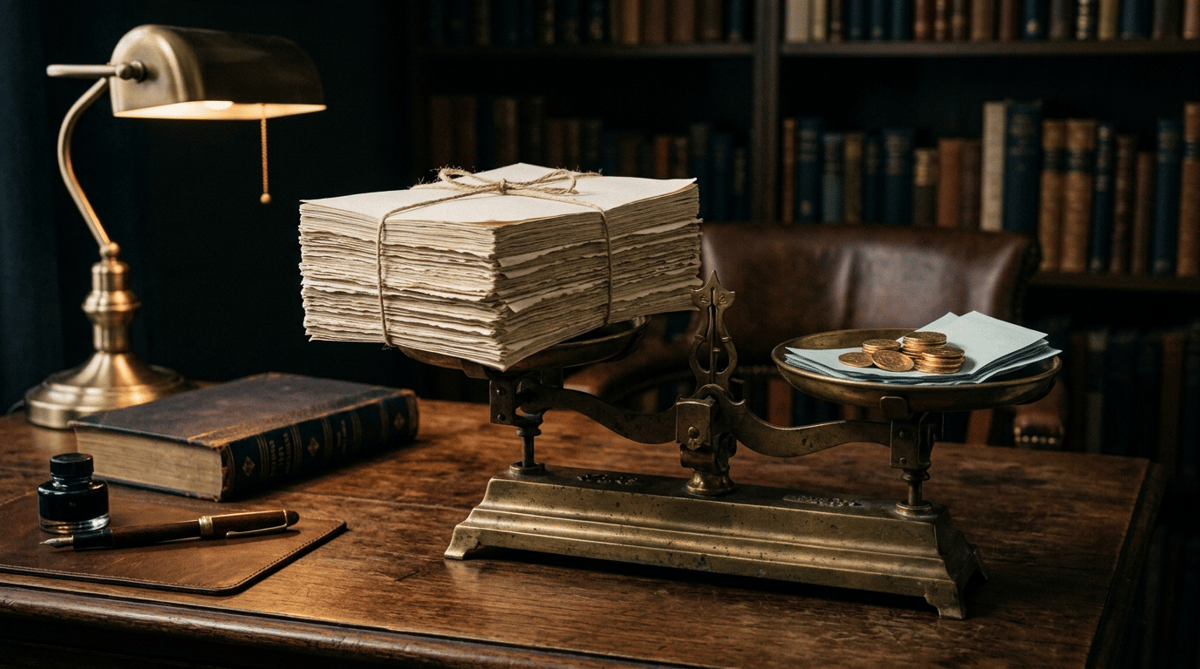
Recommended novel word counts by genre, paired with the print and Kindle Unlimited economics of every extra 10,000 words on Amazon KDP.
There is no universal correct length for a book. There is a length your genre expects, and a separate length your budget can carry, and those two numbers do not always line up. Reedsy's editorial team puts the standard novel at 70,000 to 100,000 words. Amazon's printing formula ignores genre entirely and charges you 0.012 USD for every page past 110. This guide covers both sides: what readers and editors expect from your category, and what each additional 10,000 words actually costs you in print fees, minimum list price, and Kindle Unlimited page reads. If you are still budgeting the project, read it alongside our breakdown of what book editing actually costs indie authors, since almost every editor quotes per word.
What is the standard word count for a novel?
The working benchmark across most adult fiction is 70,000 to 100,000 words, with 80,000 sitting in the middle as the safest single target. The floor matters as much as the ceiling. According to Reedsy's guide to novel word counts, a manuscript generally needs 40,000 words before the industry will treat it as a novel rather than a novella, though the thresholds are not enforced uniformly. NaNoWriMo counts 50,000 words as a completed draft, while the Science Fiction and Fantasy Writers of America set the Nebula novel threshold at 40,000.
- Short story: under 7,500 words||Novelette: 7,500 to 17,500 words||Novella: 17,500 to 40,000 words||Novel: 40,000 words and up, with 70,000 to 100,000 as the commercial norm
Plenty of celebrated books sit under the novel threshold. Animal Farm runs about 29,966 words and The Lion, the Witch and the Wardrobe about 38,421. Neither would clear a modern agent's word count filter today. That is the useful lesson: these numbers are commercial conventions, not literary laws, and they are enforced most strictly on writers who do not yet have an audience.
What are the recommended word counts by genre?
Genre is the single strongest predictor of expected length, because it encodes what readers are buying. Worldbuilding needs pages. A beach thriller does not. The ranges below come from Reedsy's editors, most of whom have acquisitions experience at traditional houses, so they reflect what gets through a submissions filter rather than what is theoretically possible.
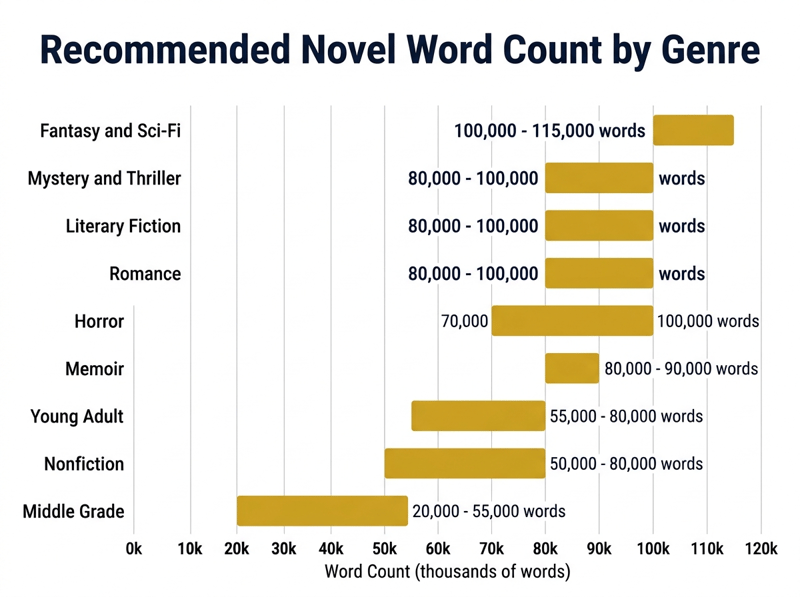
- Fantasy and science fiction: 100,000 to 115,000 words||Mystery and thriller: 80,000 to 100,000 words||Literary fiction: 80,000 to 100,000 words||Romance: 80,000 to 100,000 words, with sub-genre variation||Horror: 70,000 to 100,000 words||Memoir: 80,000 to 90,000 words||Young adult: 55,000 to 80,000 words||Nonfiction: 50,000 to 80,000 words||Middle grade: 20,000 to 55,000 words
Romance is the range that misleads people most often. The 80,000 to 100,000 band describes full-length contemporary and historical romance, but the genre carries dozens of sub-genres with their own conventions, and many category imprints publish well below 60,000. Before you commit to a target, check the actual page counts of the ten books your reader would compare yours to. That is a more reliable guide than any published range, including this one.
Are novels actually getting longer?
This is a common claim, usually blamed on Kindle Unlimited paying by pages read. The evidence is messier than the theory. Reedsy compared median word counts across its own marketplace between 2023 and 2024 and found movement in both directions. Some genres inflated. Others contracted sharply. Notably, every genre still finished inside or below its conventional range, so the drift did not break the norms.
- Horror rose the most, from a 50,000-word median in 2023 to 61,800 in 2024||Literary fiction rose from 60,000 to 66,300 words||Young adult rose from 70,000 to 73,900 words||Action and adventure fell the hardest, from 66,000 to 50,000 words||Christian fiction fell from 60,000 to 50,000 words||Science fiction fell from 79,200 to 71,300 words||Romance did not move at all, holding at a 75,000-word median
Read that list as a caution against optimising for a payout formula. If length inflation were being driven mainly by page-read economics, you would expect broad upward movement. Instead you get genre-specific swings that look more like shifting reader taste. Write to your story and your genre, then check the economics second.
What does every extra page cost you in print?
This is the part most word count guides skip, and it is the part that changes decisions. Amazon prints on demand and deducts the cost from your royalty, so page count comes straight out of your margin. The official KDP paperback printing cost page gives the formula as fixed cost plus page count multiplied by per-page cost. For a black ink regular trim paperback sold on Amazon.com, that means 1.00 USD fixed plus 0.012 USD per page.
There is one detail in that table worth more than the formula itself. Black ink paperbacks between 24 and 110 pages incur only the fixed cost of 2.30 USD, with no per-page charge at all. A 60-page book and a 110-page book cost you exactly the same to print. If your manuscript sits in the 90 to 105 page range, the next 15 pages are free. Past 110 pages the per-page meter starts running and never stops.
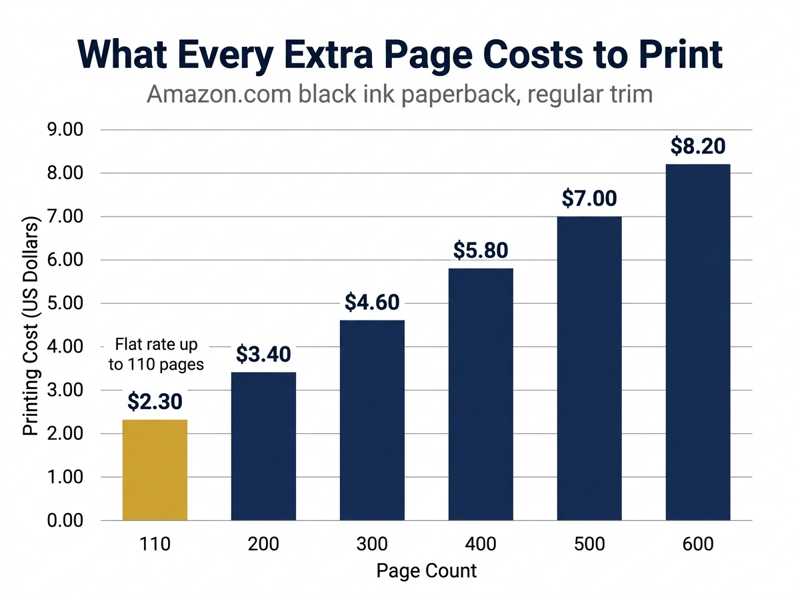
To translate word count into money you need one conversion step. A 6 by 9 inch paperback set in 11 point type runs roughly 300 words per printed page, though your real figure depends on trim size, font, and leading. KDP shows your exact page count during title setup, and the Printing Cost and Royalty Calculator will confirm the number before you publish. Using 300 words per page as a working estimate, here is what each tier of manuscript costs to print and what it forces your minimum price to be.
- 50,000 words is roughly 167 pages: 3.00 USD to print, 5.00 USD minimum list price||70,000 words is roughly 233 pages: 3.80 USD to print, 6.33 USD minimum list price||90,000 words is roughly 300 pages: 4.60 USD to print, 7.67 USD minimum list price||110,000 words is roughly 367 pages: 5.40 USD to print, 9.01 USD minimum list price||130,000 words is roughly 433 pages: 6.20 USD to print, 10.33 USD minimum list price
Those minimum prices come from KDP's own rule: it divides your printing cost by your royalty rate and refuses to let you list below the result. At the 60 percent rate that applies to most Amazon.com paperbacks, a 130,000-word epic cannot legally be listed under 10.33 USD, while a 70,000-word thriller can go out at 6.33 USD. The KDP paperback royalty page sets out how the 60 percent and 50 percent tiers apply by marketplace.
None of this argues for writing a short book. It argues for writing a book that is exactly as long as it needs to be. Padding costs real money at scale, and it costs it on every single copy sold, forever. If you are weighing print channels as well as length, our comparison of IngramSpark versus KDP Print covers how the same page count prices out differently across the two.
Does a longer book earn more in Kindle Unlimited?
In theory yes, and that theory is why people believe KU drives word count inflation. Amazon pays enrolled titles per page read, measured in Kindle Edition Normalized Pages, so a longer book that gets finished pays more than a shorter one that gets finished. The mechanism is explained on Amazon's Royalties in Kindle Unlimited page: Amazon sets a monthly KDP Select Global Fund, then divides it by every KENP page read across the platform that month.
The catch is in that second sentence. The per-page rate is not a price Amazon publishes in advance. It is a leftover, calculated after the fact, and it moves every month depending on how much reading happened relative to the fund. Length gives you more pages to be paid for, but it does not give you any control over what a page is worth.
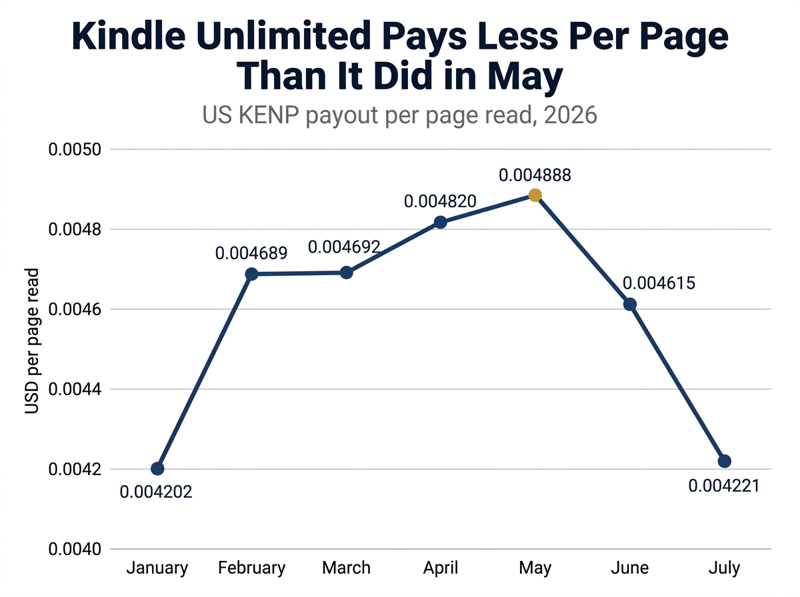
Look at the July 2026 figures together and the point sharpens. The fund actually grew to 67.6 million USD, its highest level of the year, while the per-page rate fell to 0.004221 USD, its lowest since January. More money went into the pot and each page was worth less, which means total reading grew faster than the fund did. Every extra page you write is competing against a rising volume of pages from everyone else.
There is also a completion problem that length makes worse. You are paid for pages actually read, not pages written, so a bloated middle act that makes readers stop at 60 percent converts a long book into a short payout. Read-through rate matters more than page count, and read-through is a craft problem. If you are still deciding whether KU is right for you at all, our guide to Kindle Unlimited versus going wide works through the trade-offs, and Amazon KDP royalties explained covers how page reads sit alongside your other income streams.
How do you cut an overlong manuscript?
First rule: do not do it during the first draft. Word count anxiety while drafting produces cramped, cautious writing that you will have to rewrite anyway. Finish the draft, leave it alone for a few weeks, then come back with the specific goal of cutting. The techniques below come from Reedsy's editorial contributors and they target the places where words actually accumulate, rather than asking you to trim adjectives one at a time.
- Cut transitional movement. Readers do not need to watch a character cross a room, get into a car, and park. Scene breaks do that work for free||Interrogate every piece of research. Historical and technical fiction bloats when writers cannot bear to waste what they learned. Keep only the details that move plot or reveal character||Delete explanatory dialogue between characters who already know the information. If two siblings are describing their own childhood to each other, that is exposition wearing a costume||Replace adverb and verb pairs with stronger single verbs. Walking quickly becomes striding. This compounds across a full manuscript||Search for your personal filler words. Most writers have three or four they overuse without noticing, and the word "that" is almost always the biggest offender||Cut descriptions to one precise image instead of three approximate ones
"I do find if someone has written a very short or overly long novel, they often don't quite have a grip on their story. Word counts give writers something to aim for and an idea of what a reader's expectations might be." Jackie Bates, former Managing Editor at AA Publishing, quoted by Reedsy"
That framing is the most useful one in this entire guide. Word count is rarely the actual problem. It is a symptom you can measure. A manuscript that runs 40,000 words over its genre range usually has a structural issue underneath, and cutting sentences will not fix it. If you are 20 percent over, edit line by line. If you are 50 percent over, look at whether you have written two books, or one book with a subplot that belongs somewhere else.
What if your book is too short?
Coming in under your genre range is the less discussed problem, and padding is the wrong answer to it. Readers notice filler faster than they notice brevity, and in Kindle Unlimited padding actively hurts you because unread pages pay nothing. A short manuscript almost always signals missing story rather than missing words.
- Check whether your secondary characters have arcs of their own, or whether they only exist to serve the protagonist||Look for scenes you summarised that deserved to be dramatised. Summary is often a sign you avoided a hard scene||Test whether your midpoint carries real consequence. Thin middles are the most common cause of a short novel||Ask whether the stakes escalate. If the situation at 60 percent is the same as at 30 percent, you are missing a movement||Consider whether the book is genuinely a novella. Publishing it as one honestly beats inflating it into a weak novel
The fastest way to find out which of those applies is to put the draft in front of readers who match your genre audience before you pay for a developmental edit. Our guide to working with beta readers covers how to brief them so you get structural feedback rather than line notes.
Frequently asked questions
How many words is a 300-page book? Roughly 90,000 words for a 6 by 9 inch paperback set in 11 point type, using the common estimate of about 300 words per printed page. Your actual page count varies with trim size, font, and leading, and KDP calculates the real number for you during title setup. That 300-page book costs 4.60 USD to print on Amazon.com in black ink at regular trim.
Does word count matter if I am self-publishing? Yes, for three separate reasons. Readers judge length against genre expectations before they buy. Print cost and minimum list price scale directly with page count on KDP. And in Kindle Unlimited you are paid on pages actually read, so length only converts to income if the book holds attention to the end.
Is 50,000 words enough for a novel? It clears the 40,000-word threshold that the industry generally uses to define a novel, and it is enough for young adult, middle grade, and some nonfiction. It sits well below the 80,000 to 100,000 range readers expect from adult fantasy, thriller, literary fiction, and romance. Whether it is enough depends entirely on which shelf your book is competing on.
Do longer books earn more on Kindle Unlimited? Only if readers finish them. Payment is per KENP page read, and the rate is recalculated monthly from the KDP Select Global Fund. In 2026 that US rate has ranged from 0.004202 USD in January to 0.004888 USD in May, then back down to 0.004221 USD in July. Length increases your ceiling; it does nothing for the rate or for read-through.
What is the cheapest page count to print on KDP? Anything from 24 to 110 pages, because black ink paperbacks in that band pay a flat 2.30 USD on Amazon.com with no per-page charge. A 60-page book and a 110-page book cost the same. From 111 pages onward you pay 1.00 USD plus 0.012 USD per page, so the marginal cost of length begins there.
Length gets you considered. Reviews get you read.
Hitting your genre range removes a reason for readers to skip you. It does not give them a reason to choose you. That job belongs to your cover, your description, and above all your reviews, which are the only signal on the page written by someone with nothing to sell. A perfectly calibrated 85,000-word thriller with four reviews still loses to a messier book with two hundred.
Read and Rate exists to close that gap. You upload your manuscript, it is automatically watermarked before any reviewer downloads it, and you choose which platforms you want reviews on rather than being locked to Amazon alone. Reviewers can leave you private feedback that only you see, which is often more useful during a launch than the public star rating. You also get book biometrics on how your title is actually performing, and a community of self-published authors who are solving the same problems. Start free and see what your book looks like from the reader's side.