BookBounty Alternatives: 7 Platforms Compared (2026)

A grounded comparison of 7 BookBounty alternatives for 2026: Read & Rate, Pubby, StoryOrigin, BookSirens, BookSprout, Hidden Gems, and NetGalley, with real pric
Why look beyond BookBounty?
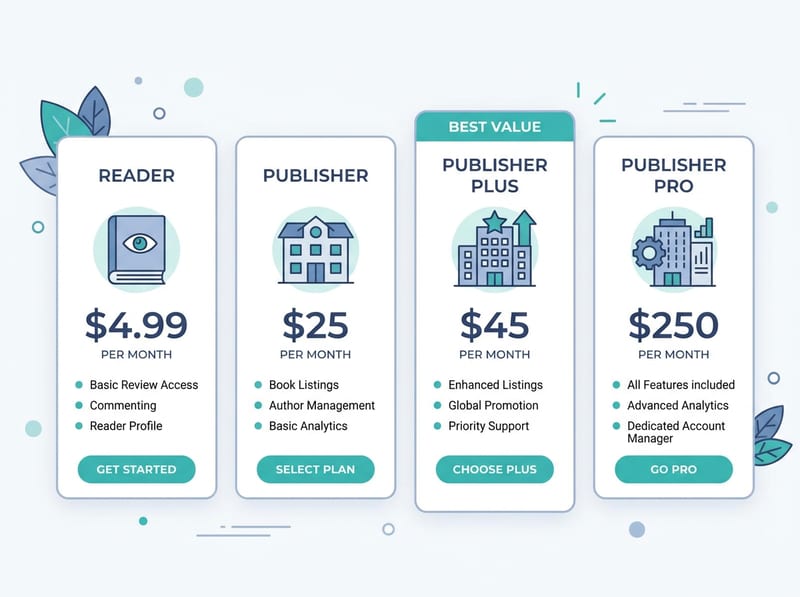
Credit where it is due: BookBounty built a genuine points economy for indie authors. You read and review other members' books through the Bounty Library to earn Bounty Points, then spend those points to open a Review Bounty on your own book, choosing between an unverified copy, a Kindle Unlimited read, or a verified purchase. According to Book Bounty's own help center, the platform hides your bounties from anyone whose books you have reviewed, a real conflict-of-interest safeguard most swap sites skip entirely.
So why look elsewhere? Three reasons come up in author communities and independent reviews. First, Book Bounty's Trustpilot rating sits at 2.8 out of 5 from 29 reviews, with 55 percent of reviewers leaving one star and several reporting that Amazon flagged their book for review manipulation after using the platform. Second, coverage stops at Amazon: a 2026 platform comparison found Book Bounty offers no path to Apple Books, Kobo, or Goodreads reviews, and lists audiobook and video review support as "coming soon." Third, the point economy still asks for your reading time every week, the same trade StoryOrigin and Pubby ask for, just measured in points instead of swaps.
How does the Bounty Point system actually work?
Points are the entire economy. Per Book Bounty's help center, you earn points by fulfilling other members' Review Bounties, then spend them to open your own, specifying whether you want unverified downloads, Kindle Unlimited reads, or verified purchases. The platform lists ten safeguards meant to keep this compliant: reviewers are not paid, names are not tied to Amazon accounts, negative reviews are not censored, and the company says it removes members for AI-generated or plagiarized reviews. Those are real protections. They do not appear to have stopped the account flags reviewers describe on Trustpilot, which is worth weighing against the price.
The Trustpilot pattern is worth reading past the star rating. Positive reviewers describe genuine, thoughtful reviews and responsive support when a reviewer disappears mid-book. The one-star reviews describe a narrower set of problems repeated by different people: a book pulled from sale after Amazon flagged "review manipulation," reviews arriving five to eight days after a reader claims the assignment, and, in a handful of cases, reviews that read as generic or AI-written regardless of the book's actual content. None of that means Book Bounty is acting in bad faith. It means a points marketplace, however well moderated, still produces a visible pattern Amazon's own systems can flag, and that pattern shows up in the public review record.
What should you compare in a BookBounty replacement?
Price alone does not tell you which platform is right. Weigh these five factors against what actually determines whether a review platform is worth your time and your Amazon account's standing.
- Compliance risk: does the model create a paper trail Amazon could read as review manipulation, or does it structurally avoid reciprocity||Platform reach: Amazon only, or Amazon plus Goodreads, Apple Books, Barnes & Noble, and more||Cost model: flat subscription, pay per point, pay per matched reader, or free||Review speed and quality: how long reviews take to post, and how many read organically versus feel templated||File security: are review copies watermarked and tracked, or can they leak to piracy sites
Weight these against your real goal. If Amazon ranking is the only thing that matters, reach beyond Amazon is a nice-to-have. If you are building a wide catalog across retailers, single-platform tools cap your upside no matter how good their Amazon results are.
1. Read & Rate: multi-platform reviews without the compliance risk
Read & Rate is a community-based review platform built specifically to avoid the swap and point-trading structures that create Amazon compliance risk. There is no Bounty Library to trade through and no point balance tying your reviews to a reciprocal obligation: reviewers request your book because they want to read it, and every copy downloads as an automatically watermarked PDF tied to the reviewer's email, which discourages leaks and gives you a paper trail if one happens. You also choose where reviews land, not just Amazon but Barnes & Noble, Goodreads, Apple Books, Google Books, and any custom review link you add, which is the single biggest gap in Book Bounty's current offering.
Two more differences matter if you care about craft, not just star counts. Every reviewer leaves a private comment visible only to you, so you get honest feedback on pacing, covers, or blurbs without it touching your public rating. And the built-in community hub works as an exchange floor where authors trade launch tactics and lessons learned, closer to a peer network than a review vending machine.
BookBounty vs Read & Rate, feature by feature
- Review platforms covered: Read & Rate reaches Amazon, Barnes & Noble, Goodreads, Apple Books, Google Books, and custom links; Book Bounty covers Amazon only, with audiobook and video reviews still listed as coming soon||Reciprocal review requirement: Read & Rate has none; Book Bounty requires spending earned points, which usually means reviewing other members' books first||File protection: Read & Rate automatically watermarks every PDF to the downloading reviewer's email; Book Bounty distributes files without a watermarking layer of its own||Private feedback to the author: Read & Rate includes a reviewer comment visible only to you; Book Bounty does not offer this||Community features: Read & Rate has a built-in hub for authors to trade tactics; Book Bounty's community lives inside its Bounty Library, focused on point exchange||Starting cost: Read & Rate is free to start; Book Bounty starts at $25 a month for authors, or $4.99 for reader-only accounts
2. Pubby: the original bounty-style platform, at a higher entry price
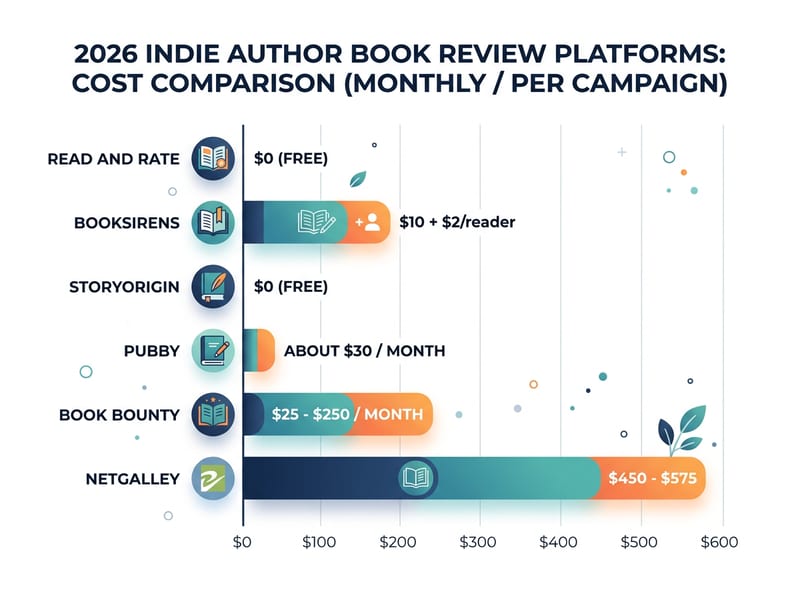
Pubby popularized the bounty-credit model Book Bounty runs on, and a 2026 platform comparison puts its entry tier at $29.99 a month, roughly $5 above Book Bounty's Publisher plan, with a similar $250 tier for authors who want to buy their way out of reviewing. If you have already weighed the two, our Pubby alternatives comparison and our Is Pubby Legit in 2026 deep dive go further into what current Pubby users report.
3. StoryOrigin: free review copies plus newsletter swaps
StoryOrigin's free Basic plan covers review copy distribution, universal book links, and email integrations at no cost, then charges $10 a month or $100 a year for the newsletter swap marketplace that builds its growth loop. It is not a bounty system: there is no point economy, so the Amazon compliance risk profile is different, but the swap marketplace still costs you time, and reviews concentrate on Amazon and Goodreads. Our full StoryOrigin alternatives comparison breaks down when the free tier is worth keeping.
4. BookSirens: pay per matched reader
BookSirens charges a one-time $10 listing fee, then roughly $2 for every reader the platform matches who downloads your ARC, with a reported completion rate near 75 percent. There is no point balance to manage and no weekly review quota, just a transparent per-result price, which makes budgeting a launch straightforward even if it costs more per review than a flat subscription.
5. BookSprout: subscription ARC distribution with review tracking
BookSprout sells tiered monthly plans that bundle ARC distribution with automatic review tracking across Amazon and other stores, aimed at authors who publish often enough that flat pricing beats paying per campaign. It shares Book Bounty's subscription structure without the point trading, which simplifies the compliance picture, though reviewer sourcing still depends on BookSprout's own reader pool rather than a broader multi-platform community.
6. Hidden Gems: curated, genre-matched reviewers
Hidden Gems is the concierge option: it matches your book to vetted, genre-appropriate reviewers and manages distribution for you rather than handing you a self-serve dashboard. Campaign costs run roughly $65 to $255 depending on reviewer count, close to Book Bounty's Publisher Plus tier but billed per campaign instead of per month, so infrequent publishers are not paying for months they do not use.
7. NetGalley: trade and library reach at a trade price
NetGalley is the only platform on this list where librarians, booksellers, and trade press actively browse for titles, with a professional reader base estimated above 400,000. That reach is priced for publishers, not point-earning authors: a direct listing runs roughly $450 to $575, which only makes sense if trade and library visibility, not Amazon star count, is the actual goal.
How do the costs actually compare?
Here is the honest range for 2026. Read & Rate costs nothing to start. Book Bounty runs $25 to $250 a month depending on tier, plus $4.99 for reader-only accounts. Pubby sits just above Book Bounty's entry tier at $29.99 a month. StoryOrigin's review copy feature is free, with swaps at $100 a year. BookSirens runs about $10 plus $2 per matched reader. BookSprout and Hidden Gems price by subscription or campaign respectively, with Hidden Gems landing around $65 to $255 per campaign. NetGalley direct listings run $450 to $575, the highest on this list by a wide margin.
Which platform fits your author profile?
- Debut author, no budget: Read & Rate first, since there is no cost and no point economy to manage before your first launch||Currently on Book Bounty and worried about compliance: Read & Rate removes the reciprocal structure entirely while keeping review volume up||Want reach beyond Amazon: Read & Rate is the only platform here covering Barnes & Noble, Goodreads, Apple Books, and Google Books natively||Publishing several books a year: BookSprout's subscription or Book Bounty's Publisher Plus tier both amortize better at volume||Want trade and library reach: NetGalley, budget permitting, stacked with a free platform for consumer reviews||Want a transparent per-reader price with no monthly commitment: BookSirens
Stacking is normal, not a workaround. Running Read & Rate alongside Book Bounty's free reader tier, or alongside BookSirens for a single launch push, reaches more of the readers who opt into advance copies than any single platform does alone.
Is BookBounty safe for your Amazon account?
This is the question that matters most, and the honest answer is that no bounty or swap platform can promise zero risk once points or credits change hands, even with safeguards in place. Book Bounty's ten listed protections, including hiding bounties from mutual reviewers and discouraging AI-generated content, are more thorough than many competitors offer. But the pattern in its own Trustpilot reviews, authors reporting Amazon flagged their book for review manipulation after using the platform, is worth taking seriously before you commit a monthly subscription to it. Amazon's own Community Guidelines prohibit reviews from anyone with a financial interest in the outcome and any arrangement that pays for a review, promised or implied, whatever platform brokers it.
How to migrate from BookBounty without losing momentum
The move takes about an afternoon. Export whatever reviewer or point history Book Bounty gives you access to, since your review history and relationships are the most valuable thing you built there. Set your book up on the new platform first, with files, review copy links, and your pitch ready, before you let your Book Bounty subscription lapse, so you are never a week without an active campaign.
Time the migration around a launch rather than during one. If you have a backlist title with reviews still trickling in on Book Bounty, let that campaign finish naturally while you run your next release through Read & Rate or whichever alternative fits your budget, so you are comparing results on your own books instead of guessing from someone else's numbers.
Frequently asked questions
Reviews are still the multiplier
Whichever platform you choose, the underlying math does not change: reviews are what make every other marketing dollar work harder, from Amazon ads to organic ranking to a reader's decision to click buy. Book Bounty's point economy works for plenty of authors, but if the compliance reports on Trustpilot make you uneasy, or you are ready to reach readers beyond Amazon, a free start with Read & Rate costs you nothing to try before you commit another monthly subscription.