Sovereignty vs. Scale: A Strategic Analysis of Publishing Models in 2026

A definitive white paper comparing the economic and strategic implications of self-publishing versus traditional paths in the 2026 market landscape.
The Economic Foundation: Margin Analysis and Lifetime Value
The fundamental divide in modern publishing is not creative, but financial. The traditional model operates on a consignment basis where the author is a supplier paid a minority stake in the net receipts. Conversely, the self-publishing model places the author as the manufacturer and retailer, absorbing risk in exchange for significantly higher retained earnings per unit. In an era of rising inflation and advertising costs, the margin per unit determines the viability of a paid acquisition strategy.
As detailed in Reedsy's 2026 Comparative Guide, the disparity in royalty rates has crystallized into the primary factor for career authors. While traditional prestige still holds social currency, it essentially caps an author's earning potential on high-volume sales, making it mathematically difficult to sustain a living wage without a massive backlist or breakout success.
This differential is not merely a bonus; it is the fuel for marketing. An indie author earning $4.00 per ebook sale can afford to spend $3.00 in advertising to acquire a customer and still profit. A traditionally published author earning $0.80 per sale is priced out of the advertising market entirely. This 'margin leverage' allows self-published authors to aggressively scale their readership using paid media, while traditional authors are forced to rely on organic reach and publisher-subsidized placement, which is increasingly rare for midlist titles.
Furthermore, the payment velocity differs radically. Traditional publishing royalties are paid semi-annually, often with a reserve against returns held back. Self-publishing platforms payout monthly (or even immediately via direct sales), providing the cash flow necessary to reinvest in the business in real-time.
The Nuance: The Advance Against Royalties Trap
A common rebuttal is the allure of the 'Advance.' However, data from Publishers Marketplace indicates that for debut and midlist authors, advances have stagnated. The advance functions as a loan against future earnings; until it is 'earned out,' the author sees zero additional income. In the current market, a significant percentage of books never earn out their advance, meaning the initial check is the only money the author ever sees.
This creates a 'winner-takes-all' dynamic. Publishers focus their marketing budget on the top 1% of titles that have large advances to recoup. If a book receives a modest advance, it often receives a modest marketing push, becoming a self-fulfilling prophecy of mediocre sales. The author is then left with a sales record that makes securing a subsequent deal difficult.
The Production Paradox: Capital Risk and Quality Control
The most pervasive myth in self-publishing is that it is the 'low cost' option. In reality, successful self-publishing in 2026 requires the author to act as a venture capitalist for their own intellectual property. The market has zero tolerance for amateurism. To compete with traditionally published books, an indie title must be indistinguishable in quality, necessitating the hiring of top-tier editors and designers who often work for the major houses as freelancers.
This shift has professionalized the sector. Gone are the days of DIY covers. The modern indie author manages a complex production workflow, coordinating developmental edits, copy edits, proofreading, and formatting. This requires not just project management skills, but liquidity. As noted in the 2026 Self-Publishing Cost Breakdown, the financial barrier to entry has risen significantly.
The Nuance: Project Management as a Core Competency
Authors must now audit their own capabilities. The 'cost' of self-publishing is not just financial; it is the cognitive load of managing a small business. Sourcing vendors, vetting contracts, and quality-checking deliverables takes time away from writing. For some, the 15% royalty of traditional publishing is a fair price to pay for outsourcing this headache.
However, 'outsourcing' in traditional publishing often means losing control. You do not get final say on the cover. You do not choose the title. In self-publishing, the capital risk buys you the veto power. You are paying for the right to position your product exactly as you envision it for your target market.
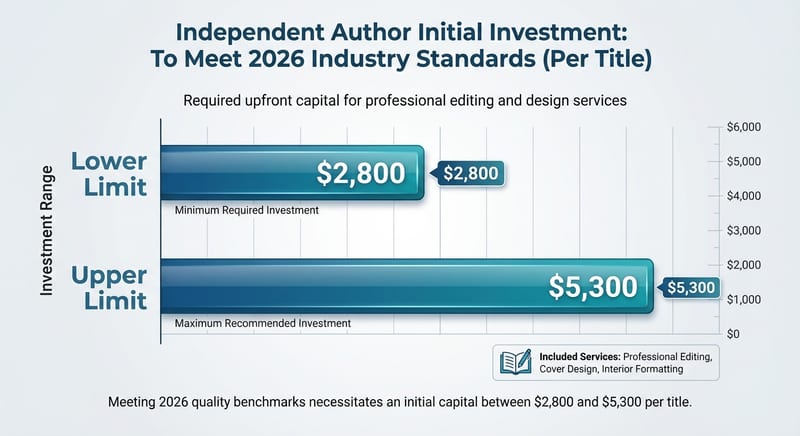
- Developmental Editing: The structural overhaul ($1,000 - $2,500).
- Copy Editing: The line-by-line polish ($800 - $1,500).
- Cover Design: The primary marketing asset ($500 - $1,000).
When you aggregate these line items, the investment becomes substantial. It is no longer a hobbyist pursuit but a startup launch.
This figure serves as a reality check. If an author cannot deploy this capital, the traditional route—despite its lower royalties and gatekeepers—remains the only viable path to professional publication without compromising quality.
Strategic Agility: The Velocity of 2026 Markets
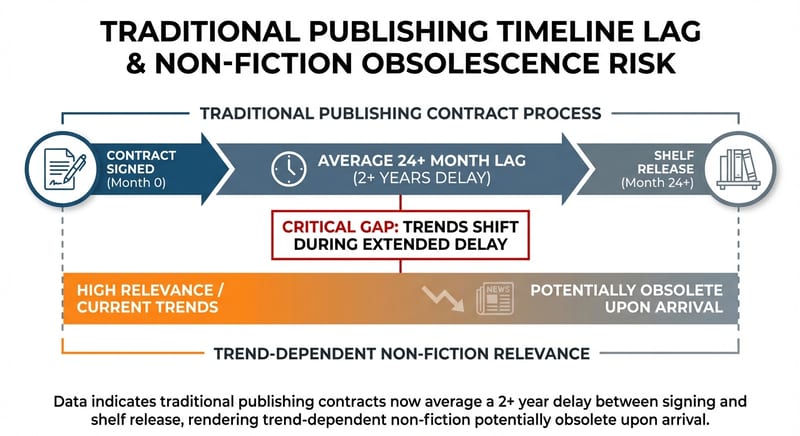
Speed is a marketing asset. In a digital ecosystem driven by trending topics (e.g., AI ethics, crypto, geopolitical shifts), the ability to publish immediately is a competitive advantage. Traditional publishing operates on a physical supply chain calendar, involving slotting fees, catalog printing, and sales conferences. This machinery is efficient for moving millions of units of a bestseller, but it is sluggish for responding to cultural moments.
Self-published authors can write, edit, and release a book within 3-4 months, allowing them to 'surf' trends while they are still rising. By the time a traditionally published book on a hot topic hits the shelves, the conversation has often moved on. This agility allows indies to dominate Amazon categories before the 'Big Five' publishers can even mobilize their acquisition teams.
"“Agility is the new scale. The ability to pivot cover art, metadata, and pricing in real-time is worth more than a placement in a physical bookstore.”"
The Nuance: The 'Slotting' Bottleneck
The traditional calendar is dictated by retailers, not readers. Barnes & Noble and other chains determine shelf space allocations months in advance. Once a book is 'slotted' for a specific release window (e.g., Spring 2027), moving it is nearly impossible. This rigidity protects the logistics chain but exposes the author to massive opportunity cost.
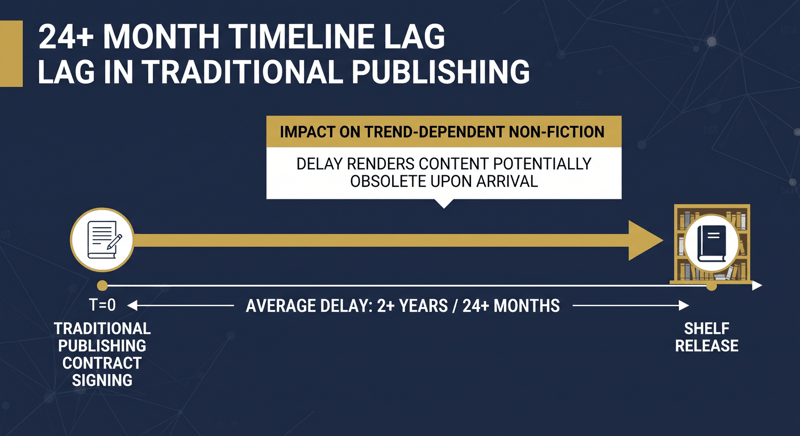
This delay is quantified in the 'time-to-market' metric. For an expert trying to leverage a book to book speaking gigs or consulting work, a two-year delay is unacceptable. The book is a business card, and you cannot wait 24 months for it to be printed.
Asset Sovereignty: The Rise of Direct Sales and Rights Retention
The emerging frontier for 2026 is 'Direct to Consumer' (DTC). Authors are increasingly bypassing retailers to sell directly through Shopify or Kickstarter. This strategy relies on owning the customer data—an asset that Amazon and traditional publishers guard jealously. When you sell direct, you own the email address, allowing for retargeting, upselling, and community building.
This ties directly into rights management. PublishDrive's 2026 Predictions highlight the 'Backlist Revival' and the importance of exploiting subsidiary rights like audio and translation. In a traditional deal, these rights are often bundled and signed away. The publisher may sit on them, leaving the audiobook unproduced or the German translation unsold.
Independent authors retain these rights. With the advent of AI translation and affordable audio production, they can exploit these markets immediately. The 'Artisan Author' keeps a tight grip on their IP, licensing it only when a partner can prove they will add value, rather than bundling it into a standard contract by default.
Conclusion: Choosing Your Business Model
The choice between self and traditional publishing is a choice between two business models: the high-volume, low-margin model of traditional retail, or the lower-volume, high-margin, high-control model of independent publishing. In 2026, with the tools of production and distribution fully democratized, the argument for traditional publishing shrinks to a specific use case: mass-market celebrity biographies and literary fiction aiming for prestigious awards. For the entrepreneurial author, sovereignty is the superior strategy.