How to Self-Edit a Book: 9 Proven Steps (2026 Guide)
Self-edit a book in 9 proven passes: structure, scenes, lines, proofing. Real 2026 editing rates, Amazon's error tiers, and what to fix before you pay.
At 2026 Editorial Freelancers Association median fiction rates, a four-stage edit on an 80,000-word novel costs $7,120 to $9,360: developmental editing at 3.0 to 3.5 cents a word, line editing at 2.7 to 3.5 cents, copyediting at 2.0 to 2.7 cents, and proofreading at 1.2 to 2.0 cents. Those figures come from a survey of more than 1,100 EFA members reporting what they actually charged during 2025.
Almost no self-published author spends that. Written Word Media's 2025 Indie Author Survey found most authors report spending $100 to $999 per book on editing, with only a small minority above $2,000. That is not a scolding. It is the real budget, and it means the passes you do yourself are not optional polish. They decide whether your one paid stage gets spent on story problems or on commas. Our breakdown of what book editing actually costs covers the pricing side. This guide covers the work that comes first.
Why does self-editing decide what your paid edit is worth?
Editors bill by scope, not by ambition. Hand a copyeditor a manuscript carrying three redundant subplots and they will copyedit it, because that is the job you bought. The subplots survive, correctly punctuated. Every hour your editor spends on problems you could have found alone is an hour not spent on the problems only they can see.
Order matters more than most authors realise. Developmental work reshapes chapters, so paying for a line edit before the structure is settled means paying to polish sentences you will later delete. Self-editing in stages, structure first and mechanics last, is what makes a single paid pass economically sensible instead of wasteful.
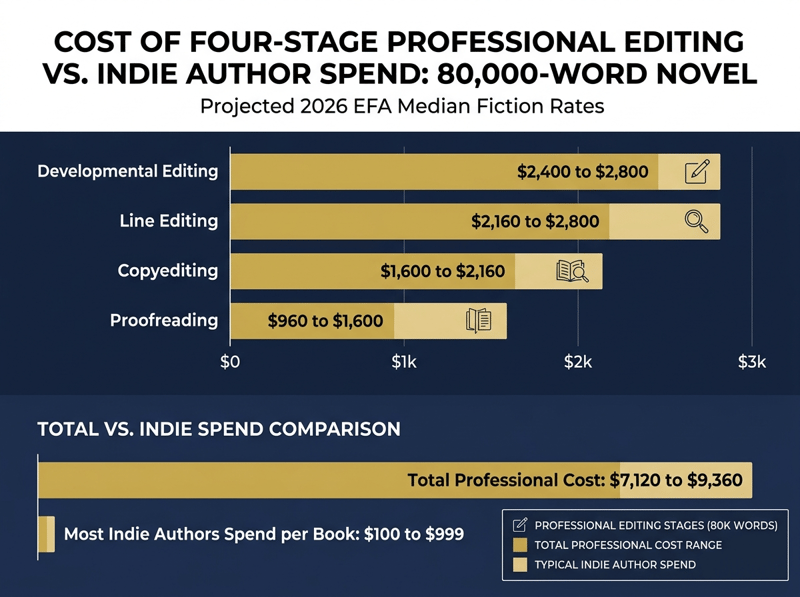
Run the arithmetic on your own book. At 2.0 to 2.7 cents a word, copyediting alone on an 80,000-word manuscript is $1,600 to $2,160. If your total editing budget is $600, you are choosing one stage rather than four. Choosing well requires knowing which stage your manuscript actually needs, and you only learn that by reading it properly yourself.
Which editing stage does your manuscript actually need?
If you can afford one paid stage, the choice should follow from what your own reading told you, not from whichever service sounds most thorough. The four stages fix different categories of problem, cost different amounts, and buying them out of order wastes money.
StageWhat it fixesEFA fiction medianCost on 80,000 wordsDevelopmental editingStructure, pacing, plot logic, character arcs3.0 to 3.5 cents a word$2,400 to $2,800Line editingSentence rhythm, clarity, voice, word choice2.7 to 3.5 cents a word$2,160 to $2,800CopyeditingGrammar, punctuation, consistency, house style2.0 to 2.7 cents a word$1,600 to $2,160ProofreadingTypos and errors in the final formatted file1.2 to 2.0 cents a word$960 to $1,600
Read that table against your own draft. If the reverse outline described in step 2 below produces chapters where nothing changes, developmental work is the gap and a copyedit will not touch it. If the outline holds up but the prose feels loose, a line edit earns its cost. If both are sound and you simply do not trust your own proofing, buy the proofread and put the rest of the budget into distribution. The one combination that never works is paying for line-level work on a structure you have not settled yet, because a later cut deletes the sentences you paid to polish.
What does Amazon actually count as an error?
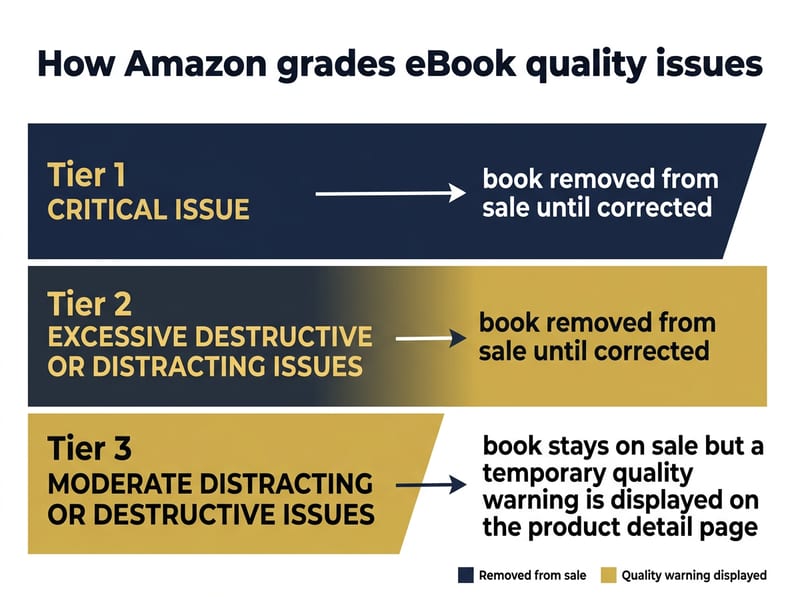
Amazon publishes its own error taxonomy and most authors have never read it. The Guide to Kindle Content Quality sorts problems into three tiers by their effect on reading: Critical issues make a book incomplete or unusable, Destructive issues prevent a reader understanding your intended meaning, and Distracting issues briefly remove the reader from your world. Amazon names typos as among the most common quality issues customers report, and lists the exact patterns it sees.
- Numbers standing in for letters, such as 5arasota instead of Sarasota||Letters standing in for numbers, such as 1o66 instead of 1066||Incorrect punctuation, such as a comma closing a sentence||Soft hyphens splitting whole words, such as re-peat instead of repeat||Missing letters, such as Nothi g instead of Nothing||HTML tags surviving in place of characters instead of the symbol they encode||Junk characters fused onto a word by a bad conversion
How many editing passes does a manuscript really need?
More than one, and the reason is measurable. Editors widely treat a 95 percent catch rate as the realistic ceiling for a single human pass. Magic Words Editing describes 95 percent as roughly the best a human achieves even under laboratory conditions. One pass therefore leaves about one error in twenty untouched. Two passes leave one in four hundred. This is precisely why traditionally published books run several copyediting rounds plus a separate proofread.
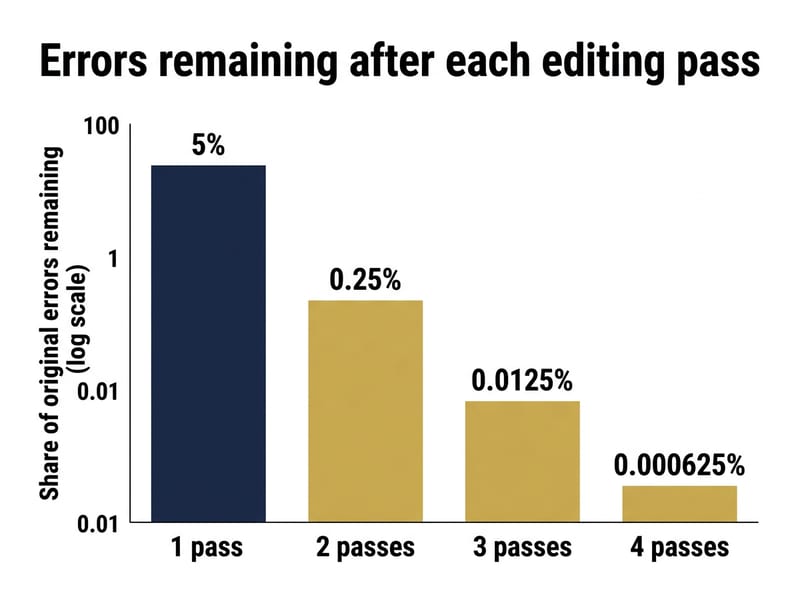
Apply that to your own schedule. If your manuscript holds 400 small errors after drafting, which is unremarkable across 80,000 words, a single careful pass still leaves roughly 20 of them in the published file. Three passes bring it to well under one. The nine steps below are grouped into three stages of three for exactly that reason. You are not repeating the same pass. You are reading for something different each time.
Stage one: the structural passes (steps 1 to 3)
Structure first, always. Nothing you fix at sentence level survives a chapter being cut. Give this stage the most calendar time and the least perfectionism, because you are making decisions about whole scenes rather than words.
Step 1: Let the manuscript go cold
Put the finished draft away for two to four weeks and do not open it. You are not resting. You are deliberately forgetting your own intentions so that you read what is on the page instead of what you meant to put there. Start the next book, outline it, catch up on admin. Authors who skip this step routinely catch structural problems only after publication, when fixing them costs a new upload and a fresh round of reader reaction.
Step 2: Build a reverse outline
Open a blank document and, chapter by chapter, write one line covering what happens, whose decision drives it, and what has changed by the end. Do not consult your original outline. Two failures surface immediately: chapters where nothing changes, and chapters where you cannot name whose choice drove the action. Both are structural, and both stay invisible while you are reading inside the prose.
Step 3: Cut the scenes that do not earn their place
Every scene should do at least two jobs: advance the plot, reveal character, deliver information the reader needs, or shift the emotional temperature. A scene doing one job is a candidate for compression. A scene doing none is a candidate for deletion, however well written it is. If a scene exists only to move characters from one place to another, a single line of transition usually replaces it without loss.
- Does the opening chapter start at the moment the ordinary changes, or several pages before it?||Can you state the protagonist's want and their obstacle in one sentence each?||Does every subplot resolve, and does its resolution change the main plot?||Are two characters serving the same narrative function, so that they could merge into one?||Does the midpoint force a decision, or does the story simply continue?||Is the climax resolved by the protagonist's choice rather than by circumstance?||Does the ending answer the question the opening asked?
Stage two: the scene and sentence passes (steps 4 to 6)
Now you work inside the scenes you have decided to keep. This is the stage where prose quality is actually made, and it is the stage most authors mistake for the whole of editing.
Step 4: Sharpen every scene opening and exit
Read only the first and last paragraph of each scene, back to back, ignoring everything between them. Openings that begin with weather, waking up, or a character arriving somewhere almost always start too early. Endings that summarise what just happened almost always run a paragraph too long. Trimming the first and last few lines of a scene is the highest-yield edit in fiction, and reading them in isolation is what makes the pattern impossible to miss.
Step 5: Run a line pass for clarity and rhythm
Work paragraph by paragraph with one question in mind: could a reader misunderstand this sentence on first pass? Break compound sentences that carry two ideas. Replace abstractions with the specific thing you mean. Vary sentence length deliberately, because uniform length reads as flat regardless of how good the vocabulary is. Expect to remove words rather than add them.
Step 6: Read the dialogue out loud
Read every line of dialogue aloud, in character, including the tags. Your ear catches what your eye forgives: speeches nobody could deliver in one breath, characters who all sound alike, and tags doing work the line should do alone. If two characters are indistinguishable with the tags covered, one of them needs a distinct rhythm, vocabulary, or verbal habit. This pass also catches most punctuation errors inside quotation marks, because you hear the pause that is missing.
Stage three: the mechanical passes (steps 7 to 9)
Mechanics come last, because everything above changes the text. These three passes are the ones that keep you clear of Amazon's quality tiers, and they are the ones a tired author skips.
Step 7: Hunt your own error patterns with search
Every writer has a personal error set, and search finds it faster than reading does. Keep a running list as you edit, then sweep the whole manuscript for each item. Amazon makes the same point about typos specifically: if one instance exists, search the full text, because the same error usually repeats and errors of a similar nature tend to cluster.
- Double spaces, doubled punctuation, and any space sitting before punctuation||Your own crutch words, found by searching the ten you already know you overuse||Straight quotes and apostrophes mixed in among curly ones||Character and place names, checked for spelling drift across the manuscript||Numbers, dates, ages and timelines, checked for internal consistency||Soft hyphens and manual line breaks left behind by copy and paste||Then versus than, its versus it is, lead versus led, and your other habitual pairs
Step 8: Change the format so your eyes stop skipping
Familiarity hides errors. Change the font, the size, the line spacing, or the device, then read again. Print is best if you can afford it, and a phone screen is a reasonable substitute because the narrow column resets your sense of the page. A text-to-speech pass works on the same principle and is the most reliable way to catch missing or duplicated words, because the machine reads exactly what is there rather than what you expect.
Step 9: Proof inside Kindle Previewer before you upload
This step gets skipped constantly and it is the one Amazon explicitly recommends. Load your file into Kindle Previewer and look for the problems that only appear after conversion: boxed question marks or jumbled characters where an accent should sit, broken tables, images whose text is no longer legible, and margin padding that eats the screen. Amazon lists body text forced to bold, italic, underline, or a non-default colour among its Critical formatting issues, so confirm your styles did not survive conversion in the wrong places.
What should you still hand to other people?
Self-editing has a hard ceiling. You cannot see your own blind spots, and you cannot experience your book as a first-time reader. Two categories of outside help stay worth paying for, and one of them is far cheaper than most authors assume.
- A manuscript assessment, 1.5 to 1.8 cents a word at EFA median fiction rates, which buys a structural read and a written report rather than line-level markup||A proofread, 1.2 to 2.0 cents a word for fiction, the last line of defence against the typos Amazon flags||Paid beta reading, 0.5 to 0.8 cents a word, the cheapest professional read available and the right choice when you need reader reaction rather than craft notes||A copyedit, 2.0 to 2.7 cents a word for fiction, if your budget stretches to one full mechanical stage
Notice the spread. On an 80,000-word novel at EFA medians, a manuscript assessment is $1,200 to $1,440, a proofread is $960 to $1,600, and paid beta reading is $400 to $640. If your budget is a few hundred dollars, an assessment or a proofread will usually return more than a partial line edit that stops halfway through the book.
Unpaid readers cover the rest. Beta readers tell you where a story loses them, which no self-edit can reveal, and our guide to finding and briefing beta readers covers how to ask questions that produce usable answers. Advance readers come later, once the file is clean, and their job is different again: they generate the early reviews that decide whether a browsing reader trusts your page at all. If you are not sure how many you need, our data on how many reviews a book needs to sell sets realistic targets.
Frequently asked questions
Clean pages are the cheapest marketing you will ever buy
Every step above protects the same moment: a reader opens your sample and decides whether to trust you. Amazon's quality tiers are the visible consequence, but the invisible one costs more. Readers who trip over three typos in the first chapter do not file a complaint. They stop reading, and they never leave the review that would have brought the next reader in.
Once the file is clean, the constraint shifts from craft to distribution. Read and Rate handles that step. You list your finished book, real readers choose it themselves, every download is watermarked to the reader who took it, and you decide which platforms you want reviews on instead of being locked to Amazon alone. Reviewers can also leave you a private comment that only you can see, which is the closest thing to a free structural read you will get after publication.