How Many Reviews Does a Book Need to Sell? (2026 Data)

Five reviews lift purchase likelihood 270 percent. Here are the review counts your book actually needs on Amazon, what readers expect, and how to get there.
The gap between zero reviews and five reviews is the largest single jump your book will ever make. Northwestern University's Spiegel Research Center measured it: a product with five reviews carries a 270 percent greater purchase likelihood than the identical product with none. Every review you collect afterward helps, but none of them will move the needle the way those first five did.
That finding reframes the question most authors ask. The useful question is not how many reviews a book needs in total. It is which counts actually change buyer behaviour, and how fast you can clear them. This guide uses published research from the Spiegel Research Center, conversion data from PowerReviews, and BookBub's own partner documentation to map those thresholds, then turns them into targets you can hit. If you need the tactics rather than the benchmarks, start with our guide on how to get Amazon book reviews.
What does the research actually say about review counts?
Book reviews are a specific case of a general ecommerce phenomenon, and the general research is far better funded than anything publishing has produced on its own. The Spiegel Research Center at Northwestern, working with PowerReviews, tracked purchase behaviour across product pages with and without reviews. Three of its findings translate directly to a book product page.
First, moving from zero to five reviews raises purchase likelihood by 270 percent. Second, the marginal value of each additional review declines sharply after the fifth. Third, reviews matter more as price rises: displaying reviews lifted conversion 190 percent for lower priced items and 380 percent for higher priced ones. For a 4.99 dollar ebook, expect the lower end of that range. For a 24.99 dollar hardcover or a premium nonfiction title, expect the upper end.
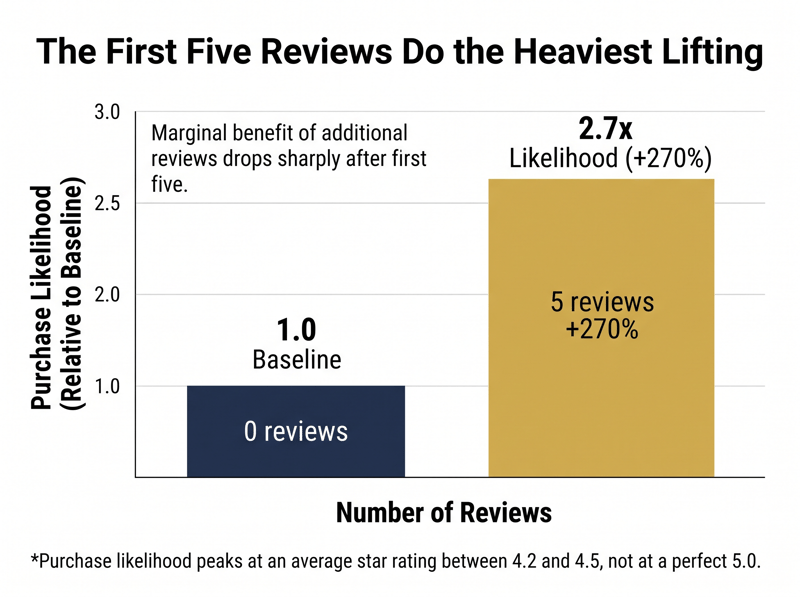
For a self-published author, this is unusually good news. Five reviews is reachable in a single launch week with a modest advance reader team. It does not require a mailing list of ten thousand people, a publicist, or a BookBub feature. It requires five readers who finish the book and post honestly.
Why do the first five reviews matter more than the next fifty?
Reviews solve a trust problem, and trust problems close fast. A page with zero reviews gives a browsing reader no evidence that anyone besides the author has read the book. The first handful removes that doubt entirely. Everything after that is refinement rather than revelation, which is why the curve flattens so quickly.
- Zero reviews reads as untested, and readers assume the book is either brand new or unwanted||One or two reviews reads as friends and family, which most readers discount heavily||Five reviews reads as a real if small readership, which is exactly where the 270 percent jump lands||Twenty to thirty reviews reads as an established book with enough sample size to trust the average rating||One hundred or more reads as a proven title, at which point the star rating itself becomes the deciding factor
The practical takeaway is sequencing. Spending three months chasing your fiftieth review on book one while book three sits at zero is a poor allocation of effort. Get every title in your catalogue past five before you push any single title toward fifty.
How many reviews do readers expect before they buy?
Behaviour and stated preference are different things, and both matter. PowerReviews surveyed shoppers on what they want to see before buying, and the numbers set a clear expectation bar. 94 percent named ratings and reviews the most important factor in a purchase decision, ahead of price at 91 percent. 86 percent said they will not buy a product without reading reviews first. Most tellingly, 68 percent said a product should carry at least 26 reviews before they will consider it, even though 53 percent read no more than ten.
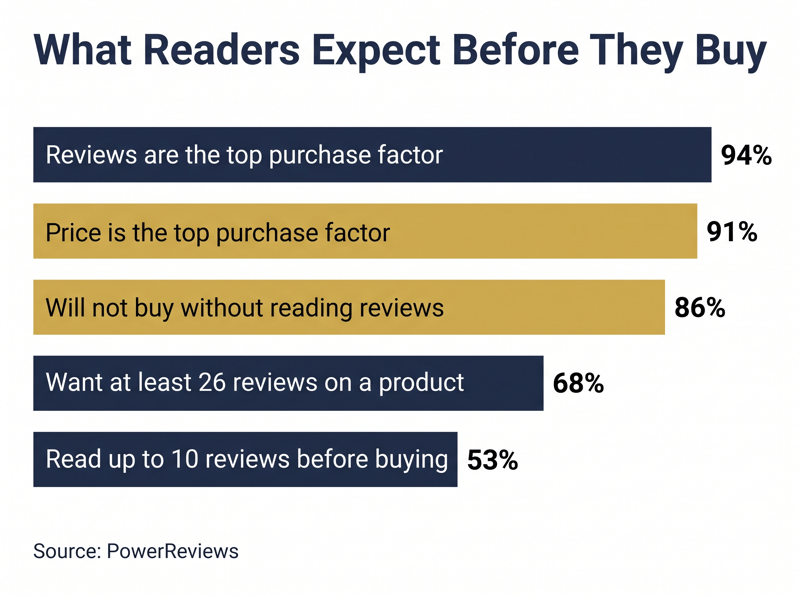
Readers are not reading 26 reviews. They are counting them. The number works as a credibility signal that gets checked in under a second, after which they read the first three and the most recent one. That is why review count and review quality are two separate jobs, and why a book with 30 short honest reviews outperforms a book with four long glowing ones.
What is the ideal star rating for a book?
Higher is not automatically better. Spiegel's data found purchase likelihood peaks when the average star rating sits between 4.2 and 4.5, then declines above that. A flawless 5.0 reads as too good to be true, and shoppers treat it as evidence of filtering or manipulation rather than quality. The rating that sells is the one that looks like a real cross-section of readers.
There is a floor as well as a ceiling. Averages below 4.0 make promotional stacking harder, because most price promotion sites weigh reader reception when selecting titles, and readers browsing a category page compare star ratings side by side before clicking anything. The working target is a 4.2 to 4.5 average across at least 26 reviews. Track it the same way you track sales, as one of your core book metrics.
Does review volume still matter after the first hundred?
Yes, but the shape of the return changes. PowerReviews analysed conversion across more than 4.5 billion site visits and 1.5 million product pages. Exposure to a page with at least one review lifted conversion 52.2 percent against pages with none. Pages carrying 11 to 30 reviews converted more than twice as well as pages with zero. Pages with 101 or more reviews showed a conversion increase of more than 250 percent.
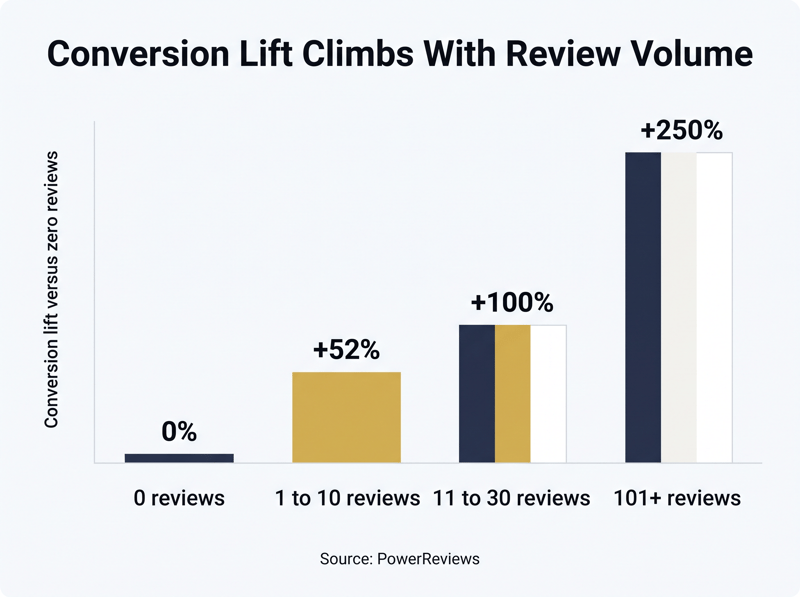
This is part of why long running backlist titles quietly outsell new releases in the same category. The older book is not better written. It has had three years to accumulate social proof, and the compounding is real. For your own catalogue, the implication is that review collection should never be treated as a launch-only activity that stops on release week.
Do promo sites require a minimum review count?
Not officially, and this is where a lot of author folklore goes wrong. BookBub has stated it applies no minimum review count to Featured Deal selection. What its submission documentation does say is that editors select only about 10 to 15 percent of the books submitted for United States Featured Deals, and that new releases are rarely chosen because titles that have had time to build up their platform and reader reviews perform best.
Read those two statements together and the real requirement becomes clear. There is no threshold to clear, but you compete against every other submission in your category, and reader reception is one of the signals editors weigh. If your book has 12 reviews at 4.6 and the next submission has 180 at 4.4, you are not out of the running, but you are not the safe pick either. Rejected authors can resubmit after four weeks, which makes review growth between attempts the single most productive thing to do with that month.
Who is actually allowed to review your book on Amazon?
Fewer people than you think. Amazon requires a reviewer to have spent at least 50 dollars on Amazon.com with a valid credit or debit card in the previous 12 months before they can submit a rating or review, and gift card and promotional balances do not count toward that threshold. Reviewers must also hold an account in good standing and must not be affiliated with the product, which rules out family members and anyone compensated for their opinion.
The practical effect is that a share of your genuine readers simply cannot review you, however much they loved the book. When you plan a review target, assume attrition between readers who finish and readers who are both eligible and willing to post. Our breakdown of the current Amazon review rules for authors covers what changed and where the enforcement lines sit.
What review targets should you set for your launch?
Targets should map to the thresholds in the research, not to a round number that feels impressive. Here is the sequence that matches the data, assuming a single title at a standard indie price point.
- Launch week: 5 reviews. This is the 270 percent jump, and it is the only target that is genuinely urgent||First 30 days: 10 to 15 reviews, enough that the average rating stabilises and stops swinging on every new post||First 90 days: 26 reviews, the credibility bar 68 percent of shoppers say they want before considering a product||First 12 months: 50 or more reviews at a 4.2 to 4.5 average, the range where promo site submissions become competitive||Ongoing: treat 101 reviews as the long term goal, since that band shows the largest measured conversion lift
If you are behind on these numbers, the fix is almost never a bigger advertising budget. Ads put your cover in front of buyers, not reviewers. Falling short on reviews is a distribution problem: not enough of the right readers are getting the book with a clear, legitimate request attached.
How do you hit those numbers without breaking Amazon's rules?
Every legitimate method comes down to the same mechanic. Get the book to readers who already want that kind of book, make posting easy, and ask once, clearly. What separates the approaches is how many qualified readers each one can reach.
- Advance reader copies: send the book free before or at launch to readers who opted in, then ask for an honest review on release day||Back matter ask: put a short, specific request on the last page, since readers who reach it are by definition the most likely to post||Your email list: the highest converting channel you own, and the only one nobody can take away from you||Review platforms and author exchange communities: these reach readers outside your own audience, which is the wall most first-time authors hit||Ongoing promotion: keep putting the book in front of new readers after launch week, because review count compounds and launch week does not
One caution on free copies. A review only carries Amazon's Verified Purchase badge when the reviewer bought the book through Amazon, so reviews from free advance copies appear without it. That is normal and permitted, but a page where every single review is unverified and posted inside the same 48 hours looks engineered. Mix your sources and spread the timing. Our guide to ARC book reviews covers how to run that process properly.
Frequently asked questions
Your first 26 reviews are the ones that matter
Every threshold in this article comes down to the same bottleneck. You need your book in front of enough readers who are willing and eligible to post, and you need it to keep happening after launch week ends. That is a distribution problem, and advertising does not solve it.
Read and Rate was built for exactly that step. You list your book, real readers choose it themselves, every copy they download is watermarked to them, and you decide which platforms you want reviews on instead of being locked to Amazon alone. Each reader can also leave you a private comment that only you see, which is where the useful feedback usually lives. It is the shortest honest route from zero to five, and from five to 26.