Spotify AI Audiobooks Expand to 21 New Markets (2026)

Spotify's free AI audiobook tools now reach authors in the UK, Canada, Australia, Spain and Latin America. See who qualifies, the limits and the royalties.
Until this week, a novelist in Manchester, Toronto or Madrid who wanted a free AI-narrated audiobook had few options from the biggest audio storefronts. Amazon's virtual voice program runs as a beta in the U.S. marketplace, and Spotify's own creation tool was limited to US authors writing in English when it left beta in September. That changed on 18 November, when Spotify announced in its official newsroom that the tools now reach 21 more markets.
The timing matters. Spotify is also rolling out audiobook listening from 22 markets to more than 180 by the end of 2026, so an author in one of the new markets can now create an audiobook locally and sell it to listeners far beyond their own country. We covered the original US launch in Spotify AI Audiobooks Open to All US Indie Authors. This article focuses on what is new, who it helps, and what to check before you spend one of your five free slots.
What did Spotify announce on 18 November 2026?
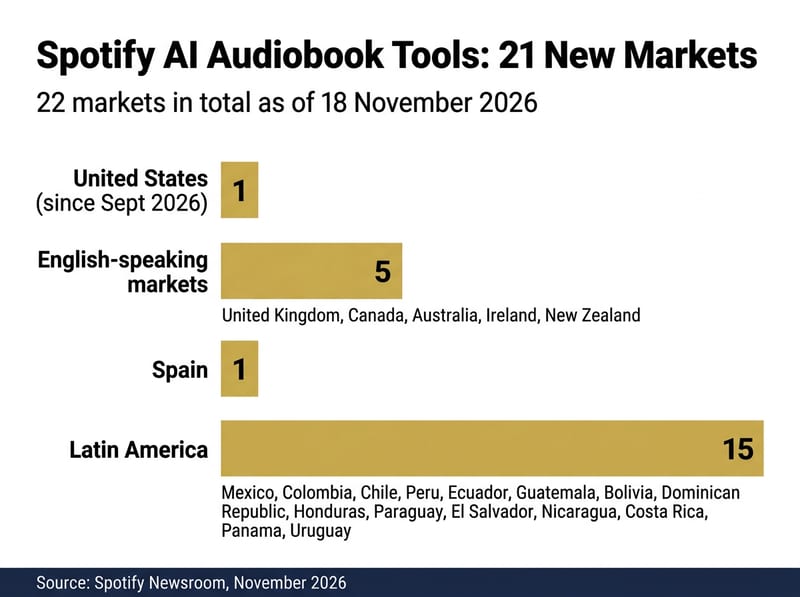
Spotify's announcement is short and specific. Audiobook Creation Tools, which launched for US self-published authors in September, are now available to eligible self-published authors in 21 additional markets. The company also added Spanish-language support, so authors can turn Spanish manuscripts into Spanish audiobooks, and said its voice library now includes new Spanish voices from ElevenLabs.
The 21 new markets fall into three groups, which is the easiest way to see who benefits:
- Five English-speaking markets: the United Kingdom, Canada, Australia, Ireland and New Zealand||One European Spanish-speaking market: Spain||Fifteen Latin American markets: Mexico, Colombia, Chile, Peru, Ecuador, Guatemala, Bolivia, the Dominican Republic, Honduras, Paraguay, El Salvador, Nicaragua, Costa Rica, Panama and Uruguay
Add the United States and the tool now covers 22 markets. The workflow is unchanged: upload a finished manuscript as an EPUB, choose a voice from a curated library of licensed digital voices, preview every chapter, adjust pronunciation, and approve. Spotify states plainly that nothing goes live until the author approves it.
Who is eligible now, and what are the limits?
Eligibility comes down to three things: you are a self-published author in one of the 22 markets, you have a finished manuscript in EPUB format, and you have a validated payment profile on file in Spotify for Authors. Spotify says the payment profile is required to get access to the free tools at all, so set it up first. The September launch post added that some limits on usage and audiobook generation apply, and Spotify's help center spells them out.
- Five free audiobooks per Spotify for Authors account, confirmed again in the 18 November announcement||Four generations per audiobook project, and a generation is used each time you generate or regenerate, including edits after publishing||Manuscripts of 500,000 characters or fewer, according to Spotify's current help page on creation limits||EPUB input only, with chapter previews and a pronunciation review step before you publish||A Narrated by Digital Voice label on every title made with the tool||Most audiobooks published within 72 hours of processing, per Spotify's help center
One detail trips people up. Spotify's creation limits page says a slot is used the moment you create a project, whether it ends up as a draft or a published title, and that once a slot is used it is permanent. Deleting a draft or unpublishing the audiobook does not give it back. Some Spotify help pages still describe the tool as US and English only; the 18 November newsroom post is the more recent statement, so rely on it for country and language eligibility.
Why does the expansion matter so much outside the US?
Because Amazon's free alternative stops at the US border. Amazon's KDP help page on virtual voice describes it as a beta launched in the U.S. marketplace, joined through an interest list, with list prices between $3.99 and $14.99 and a 40 percent royalty on a la carte sales. That is a useful program, but a UK or Australian author selling mainly on their home Amazon store has no equivalent free AI option from Amazon today.
The same page also explains the opportunity. Amazon states that only 5 percent of all books on Amazon are released as audiobooks. For most indie authors, the reason is cost. Human narration remains a serious investment, as we detailed in Audiobook Production Cost: What Indie Authors Pay, and that cost has kept most backlist titles out of audio entirely.
Spotify's expansion lowers that barrier for authors in 21 more markets at once, and it pairs a production tool with a much larger storefront. That combination is new for authors in Canada, Ireland, New Zealand and Latin America in particular, where local audiobook options have been thin.
How many authors are actually using Spotify's tool?
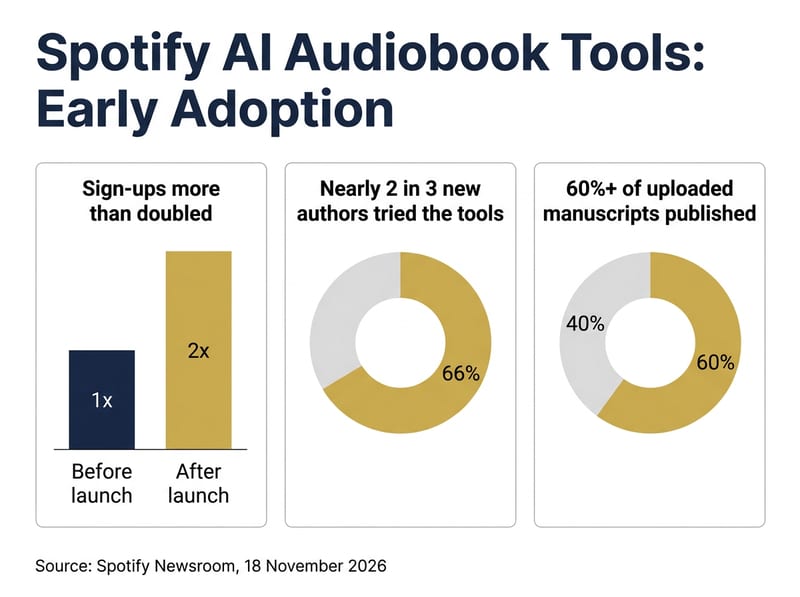
Spotify shared three adoption figures with the announcement, and they are worth reading carefully because they describe behavior rather than marketing promises. Since the US launch, sign-ups to Spotify for Authors have more than doubled. Nearly two in three new authors have tried Audiobook Creation Tools. And more than 60 percent of uploaded manuscripts have gone on to be published.
The last number is the most useful one for you. It means roughly four in ten uploaded manuscripts did not become published audiobooks, whether because the author was unhappy with the narration, ran into pronunciation problems, or simply stopped. Spotify also said listener return rates for these titles are in line with other self-published audiobooks on its platform, which suggests listeners are not rejecting digital narration outright. Spotify did not publish absolute author numbers, so treat these as directional signals rather than market sizing.
Where will your audiobook be heard, and how much do listeners get?
Creation is only half the story. On 7 October, TechCrunch reported that Spotify was expanding audiobooks to more than 180 markets, with a rollout continuing over the following months. Spotify cited more than 350,000 titles in over 120 languages and said more than 750 million users would gain access. Spain alone was getting more than 45,000 Spanish-language titles.
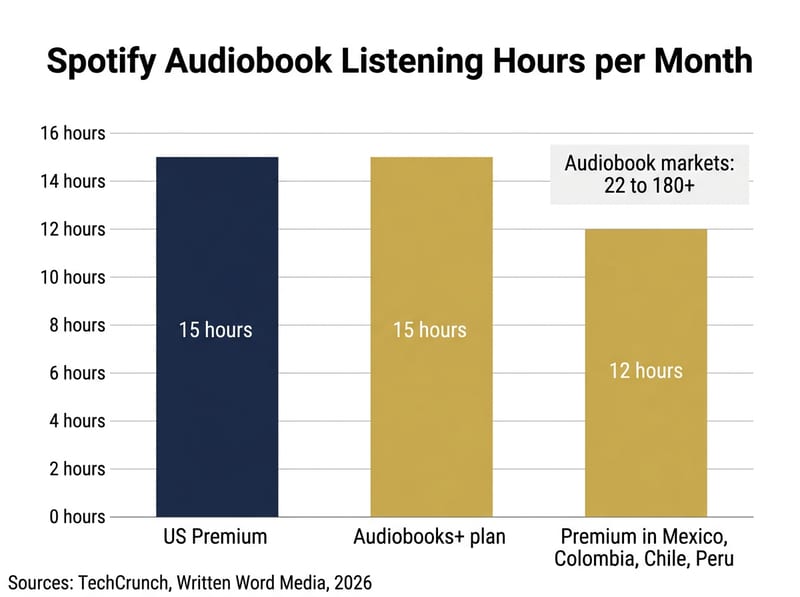
How listeners pay varies by country, and that shapes how your book gets discovered. In the US, Premium subscribers get 15 hours of audiobook listening per month, according to Spotify's head of product speaking to Written Word Media. In eligible expansion countries such as Mexico, Colombia, Chile and Peru, TechCrunch reported a 12-hour monthly Premium allowance, while the stand-alone Audiobooks+ plan carries a 15-hour allowance. Listeners can also buy titles individually.
Spotify is clearly investing in the category. TechCrunch put Audiobooks+ at more than 1 million subscribers and over $100 million in annual recurring revenue, with monthly audiobook listeners up 40 percent and listening hours up 30 percent. PPC Land noted that Spotify's country list for the rollout contains 181 entries and quoted the company's position that all of its partnerships are non-exclusive.
How much does Spotify pay for audiobooks?
Spotify pays two kinds of royalty, and its royalty help page names both: a la carte purchases, and streams by Premium subscribers whose plan includes audiobooks. For a la carte sales, Spotify's head of product told Written Word Media that royalties are 50 percent of the suggested retail price you set, and ScribeCount reports the same rate. The subscription pool pays a pro rata share of listening that Spotify does not publish.
Authors in the new markets should also read the payment section closely. Spotify pays royalties in US dollars. Authors paid through Tipalti may choose Canadian dollars, which carries exchange fees, and Spotify notes that your payment provider can affect the minimum amount you can receive and any processing or exchange rate fees. Spotify says authors on Spotify Payouts receive monthly payouts, with some months including quarterly earnings. ScribeCount reports that non-US authors are paid through Tipalti, so check which provider your account uses before you assume a payout schedule.
The practical takeaway: price your audiobook in a range listeners in your strongest market will actually pay, and judge the subscription income only after a full quarter of your own royalty reports. Nobody outside Spotify can tell you the pool rate in advance.
How does Spotify now compare with KDP Virtual Voice and ACX?
For an author outside the US, the comparison has shifted. The table below uses each platform's published terms as read this week.
FeatureSpotify Audiobook Creation ToolsKDP audiobooks with virtual voiceACX with a human narratorCost to produceFree for up to 5 audiobooks per accountFreeNarrator paid per finished hour or through royalty shareWhere authors can use itUS plus 21 markets, including UK, Canada, Australia, Spain and Latin AmericaBeta in the US marketplace, via interest listRights holders in ACX's supported countriesLanguagesEnglish and Spanish80 voices, including English, Spanish, French and ItalianAny language a narrator recordsA la carte royalty50% of your suggested retail price40% on list prices from $3.99 to $14.9950% exclusive or 30% non-exclusive under the 2026 model (per Vappingo)Main storefrontSpotify, in more than 180 marketsAudible, Amazon, Alexa, Amazon Music UnlimitedAudible, Amazon and other retailersLabelNarrated by Digital VoiceLabeled as virtual voiceNo AI label
Amazon's subscription side is changing too. Kindle+ (formerly Kindle Unlimited) now pays for listening as well as reading. KDP's royalty help page, as quoted by Inkfluence AI, says you are paid for the first time a subscriber reads or listens to a given page in your book, and KDP states that virtual voice audiobooks made from KDP Select ebooks are also included in Audible's Plus catalog. We explained that shift in Kindle Unlimited Is Now Kindle+: What Changes for Authors.
On ACX, Vappingo summarizes the new royalty model as 50 percent for exclusive and 30 percent for non-exclusive titles, with the legacy 40 and 25 percent rates phasing out by the end of 2026. Our breakdown of that change is in Audible's New Royalty Model: What ACX Authors Must Do.
What should Spanish-language authors do first?
Spanish support is the quieter half of this announcement, and potentially the bigger one. Spotify's September launch post said the tools supported English-language titles only and pointed non-English authors to ElevenLabs Studio, which has its own fees and terms. As of 18 November, a Spanish manuscript can become a Spanish audiobook inside Spotify for Authors at no cost, for up to five titles.
Spotify did not say how many Spanish voices are available, whether they cover both Castilian and Latin American accents, or whether Spanish titles have different limits. Preview carefully. A voice that sounds natural to a reader in Mexico City may sound foreign to a listener in Madrid, and your preview chapters are the only way to judge that before you spend a generation.
Bilingual authors have a particular opportunity. If you have an English edition and a Spanish translation, you can produce both audio editions with the same five slots, which makes slot planning even more important.
A 7-step plan for authors in the new markets
- Set up and validate your Spotify for Authors payment profile, and note whether you are paid through Spotify Payouts or Tipalti||Pick your best candidates for the five slots: backlist titles with steady ebook sales and existing reviews usually make the safest first tests||Check your existing audio rights, including any exclusive ACX agreement or publisher contract for the same title||Export a clean EPUB with proper chapter breaks, and confirm it is under 500,000 characters||Build a pronunciation list of character names, place names, invented terms and acronyms before you create the project||Preview chapter one and any chapter a browsing listener is likely to sample, and ask two or three readers to listen too||After publishing, send early listeners to review the audiobook, and compare a full quarter of royalty reports before deciding on the next slot
This order matters. The first three steps can rule a book out before you spend anything, and the last two decide whether the audiobook earns its place in your catalog.
"Bringing these tools to 21 more markets means many more stories can find listeners." Chester Lau, Author Growth at Spotify, 18 November 2026"
What does this change for reviews and discovery?
A new audio edition starts with zero ratings, and an audiobook with no social proof gets skipped just like an ebook with none. Our data post on how many reviews a book needs to sell shows why early reviews matter so much for conversion.
The authors who benefit most from Spotify's expansion will be the ones who already have readers. If your ebook has an engaged review base, those readers are your natural first listeners. If it does not, build that base before you spend a slot, so that the audiobook launches into an audience rather than into silence.
Frequently asked questions
Audio is now a global option, and readers still decide
Spotify has turned free AI narration from a US perk into an option for authors across the English-speaking world, Spain and most of Latin America. The limits are real: five permanent slots, four generations each, a digital voice label, and a subscription rate nobody outside Spotify can see. Used deliberately, on the right backlist titles, it is the cheapest way most indie authors will ever get a book into audio.
Whatever you produce, it will need readers who care enough to leave a review. Read & Rate puts your book in front of real readers, lets you choose the platforms where you want reviews to land, from Amazon and Goodreads to custom links, and gives you private feedback from every reviewer. Start your free trial and build the audience your audiobook will launch into.