Spotify AI Audiobooks Open to All US Indie Authors (2026)
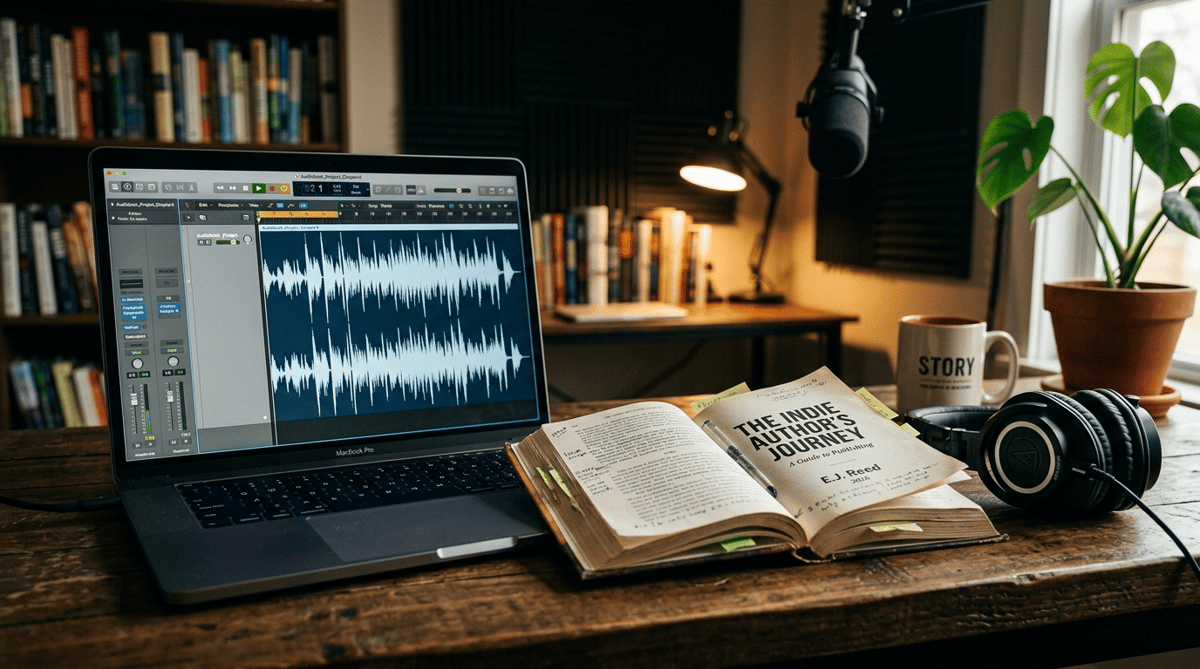
Spotify has opened its ElevenLabs-powered Audiobook Creation Tools to every self-published author in the United States. Here is what the tool does, what it pays
The announcement matters because of who it reaches, not because AI narration is new. Spotify has accepted ElevenLabs audio since February 2025, and Amazon has run its own virtual voice beta inside KDP for longer. What changed this month is that the production step moved inside Spotify for Authors and the invite list disappeared. The Alliance of Independent Authors called it the big news of the week, and the #PublishingReinvented newsletter confirmed the same expansion on 14 September, adding that a validated payment profile is required before you can publish.
It also lands in a year when audiobook economics are being rewritten. Audible is retiring its legacy ACX royalty model by the end of 2026, which we broke down in Audible's New Royalty Model: What ACX Authors Must Do, and the wide versus exclusive decision that used to be an ebook question, covered in our Kindle Unlimited vs going wide guide, now applies to audio as well. Below is what Spotify actually shipped, what it pays, how it compares with KDP's virtual voice and a human narrator, and a checklist to run before you use one of your five slots.
What did Spotify announce on 9 September 2026?
Spotify first showed the tool at its Investor Day on 21 May 2026. As TechCrunch reported at the time, the ElevenLabs-powered feature was to launch in beta in June, invite-only, English only, and with no exclusive contract attached. Three months later the beta gate is gone. Any self-published author based in the US can log in to Spotify for Authors, open the Audiobook Creation Tools, and convert a finished manuscript. Authors outside the US, and books in languages other than English, are still waiting.
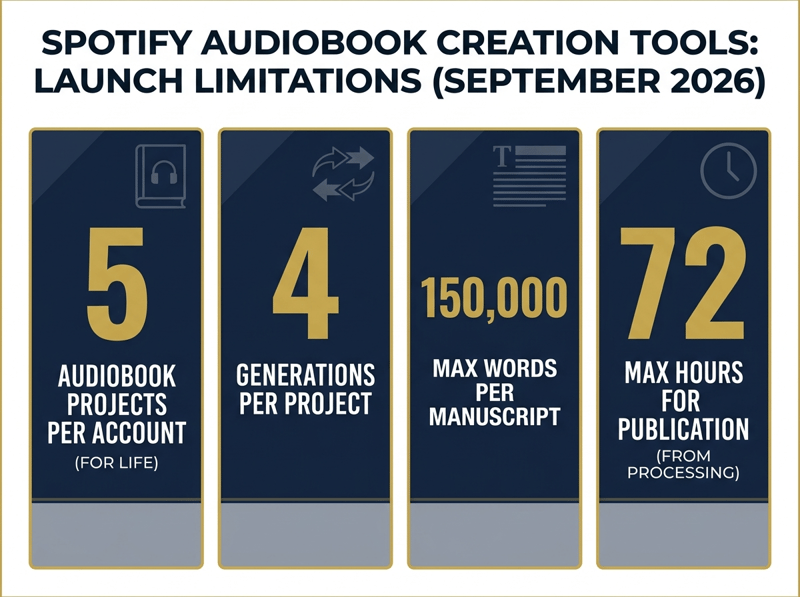
The workflow, per Spotify's own help center, is five steps: upload your manuscript as an EPUB, choose a digital voice and preview it, review pronunciations for names, places and acronyms, listen to chapter previews, then submit. Once processing finishes, the audiobook is published to Spotify automatically, most within 72 hours. Every title made this way carries a Narrated by Digital Voice label on Spotify, and you have to accept the Audiobook Creation Opt In Terms of Use before you can start.
- Narration by an ElevenLabs digital voice, with a choice of voices to preview||Distribution to Spotify, where the audiobook is published automatically after processing||A pronunciation review step before you publish, for names, places, acronyms and unusual terms||Chapter previews so you can hear the result before the final audiobook is generated||No exclusivity: you keep the right to produce and sell other audio editions elsewhere||Free for up to five audiobook projects per account
Why is Spotify doing this now?
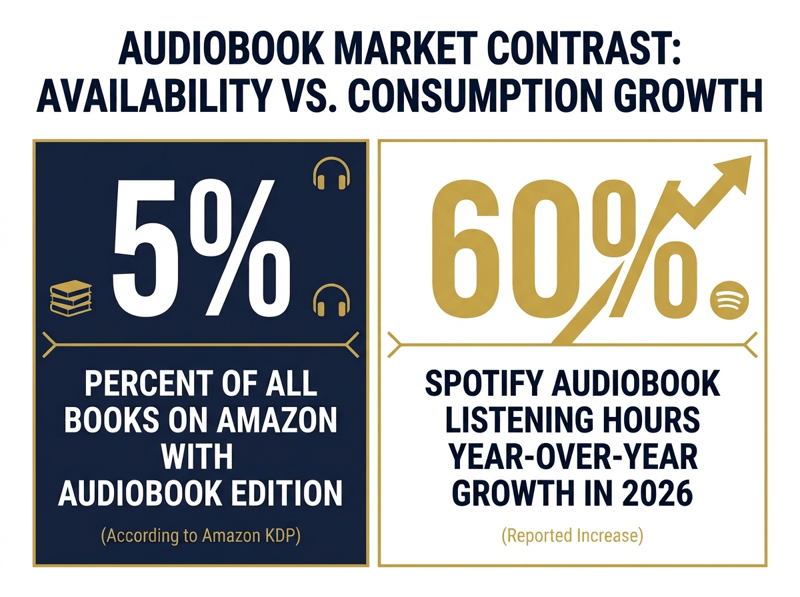
Because Spotify needs supply. At the same Investor Day, the company said its audiobook catalog had reached 700,000 titles, that it had passed one million Audiobook+ subscriptions, and that the audiobook business was on track for $100 million in annualized recurring revenue. Listening hours were up 60 percent year over year, and more than half of its audiobook listeners had started listening within the previous twelve months. A catalog that size still has holes, and the fastest way to fill them is to let authors produce audio editions without paying a studio.
The supply gap is measurable. Amazon's own KDP help page on audiobooks with virtual voice states that only 5 percent of all books on Amazon are released as audiobooks. Meanwhile the Audio Publishers Association put US audiobook revenue at $2.43 billion for 2025, up 9 percent, with active titles up 43 percent to more than 750,000, figures we examined in our coverage of Audible's royalty change. Demand is growing faster than the number of books that exist in audio, and every platform with a subscription plan to fill wants your backlist in it.
The tool is one piece of a larger storefront. Spotify said it would add ten more languages to Spotify for Authors, including French, Canadian French, German, Dutch, Latin American Spanish, Swedish, Finnish, Icelandic, Danish and Norwegian. It launched audiobook charts in February 2026, and in April it began letting authors sell physical books to listeners in the US and UK. Read those moves together and the direction is clear: Spotify wants to be the place where a listener discovers your book, streams it, buys it, and orders the paperback, without ever visiting Amazon.
How does Spotify's tool compare with KDP Virtual Voice and ACX?
Indie authors now have three realistic routes to an audio edition: Spotify's new tool, Amazon's virtual voice beta inside KDP, and a human narrator through ACX or an independent studio. They differ on cost, on what you earn per sale, and above all on where the finished audiobook can be heard. The table uses each platform's published terms as of September 2026.
FeatureSpotify Audiobook Creation ToolsKDP audiobooks with virtual voiceACX with a human narratorCost to produceFree for up to 5 projectsFreeNarrator paid per finished hour or through a royalty shareWho can use itUS-based self-published authors, English EPUBKDP authors in the US marketplace beta, from an eligible KDP ebookRights holders in ACX-eligible countriesVoicesElevenLabs digital voices80 virtual voices across 7 languages and accents, one voice per chapter allowedA human narrator you audition and chooseRoyaltyTwo streams: a la carte purchases and Premium plan streams; ScribeCount reports 50 percent of list price on a la carte sales, pool rate not published40 percent on a la carte sales, list price $3.99 to $14.99, plus an Audible Plus fund for KDP Select titles50 percent exclusive or 30 percent non-exclusive under Audible's new modelWhere it sellsSpotifyAudible, Amazon, Alexa, Amazon Music UnlimitedAudible, Amazon and Apple Books, or wider if non-exclusiveExclusivityNone requiredTied to the KDP ebook it was created fromOptional; the choice sets the rateListener labelNarrated by Digital VoiceClearly labeled as virtual voiceNoneHard limits5 projects, 4 generations each, 150,000 words, English onlyUS marketplace only, price band fixedProduction time and narrator cost
Royalty percentages alone will mislead you here. Spotify's royalty documentation distinguishes two kinds of income, direct purchases and streams by Premium subscribers whose plan includes audiobooks, and only the first has a rate that outside guides such as ScribeCount put a number on. The subscription pool pays a pro rata share of listening that Spotify calculates and does not publish. KDP's 40 percent looks lower on paper, but it puts your title in front of Audible's customer base. Neither number tells you which platform will earn more for your specific book, so treat the free Spotify edition as an experiment with a real report attached, not a replacement for the platform where your readers already are.
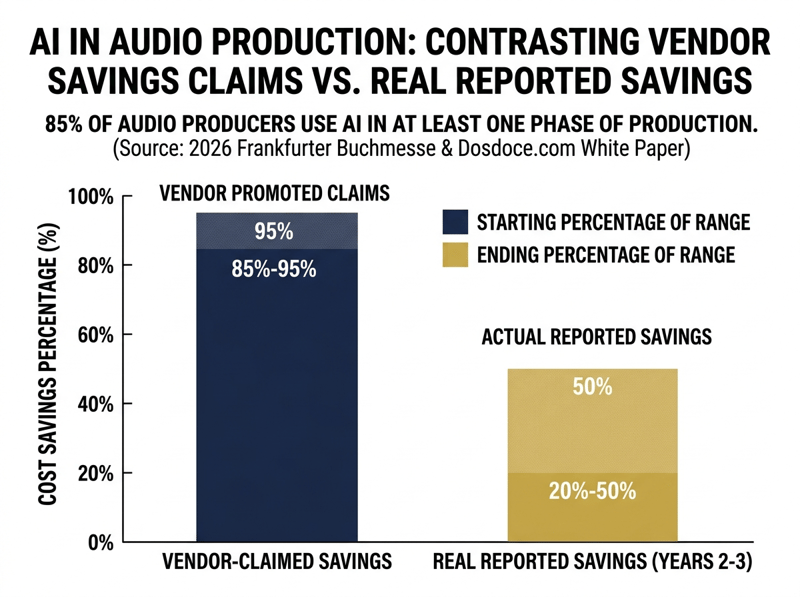
The bigger correction is on cost. A white paper published this month by Frankfurter Buchmesse and Dosdoce.com, drawing on 53 questionnaire responses and 32 further interviews with publishers, studios and distributors, found that 85 percent of audio producers now use AI in at least one production phase. Technology vendors promote savings of 85 to 95 percent; the producers themselves report 20 to 50 percent by the second and third year, because AI rarely covers the whole workflow. For a self-published author the free price tag is real, but the hours you spend on pronunciation lists, chapter previews and quality checks are the cost that never appears on the invoice.
What does the digital voice label mean for listeners and reviews?
Every audiobook made with Spotify's tool is labeled Narrated by Digital Voice, and the industry is pushing for more of that, not less. In the Dosdoce.com study, 90 percent of respondents said the sector needs greater disclosure toward authors and consumers before AI audio can scale, 86 percent named voice quality and rights transparency as their top criteria for choosing a vendor, and 60 percent called for ethically licensed voice datasets with fair pay for voice talent. Half of the barriers to scaling, according to the same report, come from restrictions set by authors, agents and publishers themselves. The people who make books are still the most cautious party in the room.
Listeners may care less over time. When Spotify first accepted ElevenLabs titles through Findaway Voices in 2025, every description was prefixed with the line "This audiobook is narrated by a digital voice," and MIDiA Research argued that as synthetic voices improve, the label will become moot for most consumers who listen for convenience. That may be true in aggregate. It is not true of the reader who hits a mispronounced character name in chapter one, because that reader writes the review. Audiobook reviews talk about narration constantly, and our analysis of how many reviews a book needs to sell applies to the audio edition as a separate product with its own rating.
Treat the audio edition as a product that needs its own proof. Readers who reviewed your ebook are the natural first listeners, and Read and Rate lets you point reviewers at the platforms where you want the review to land rather than assuming everything goes to Amazon. If you have not yet built that reader base, our guide to finding beta readers and the communities where indie authors actually get help are the places to start, because the one thing a digital voice cannot generate for you is a listener willing to say it worked.
Should you convert your book? A 7-point checklist before you use a slot
Free is not the same as costless when the slot is permanent. Run through these seven checks before you create a project, in this order, because the early ones can rule a book out entirely and the later ones decide whether the result is worth attaching your name to.
- Check your existing audio rights. If you already have a human-narrated edition under an exclusive ACX agreement, or a rights deal with a publisher, confirm in writing that a second, AI-narrated edition on Spotify does not breach it||Confirm the book is under 150,000 words and that you have a clean EPUB. A file exported from a formatting tool with proper chapter breaks will map to audiobook chapters; a Word document saved as EPUB with no structure will not||Decide which five books deserve a slot. Backlist titles, series openers you use as funnels, and niche nonfiction that would never justify a narrator fee are the strongest candidates. A flagship title with a loyal audience may deserve a human narrator instead||Build the pronunciation list before you generate anything. Character names, place names, invented words, foreign phrases and acronyms all need entries, and the review step is where they get fixed||Listen to the previews with the four-generation budget in mind. Use the first generation to catch systematic problems, keep at least one in reserve for a fix after publication, and never spend a generation on a change you have not previewed||Plan how the audio edition gets reviewed. Decide which readers you will ask to listen, where you want the reviews to appear, and how you will link the audiobook from your ebook back matter and author page||Set expectations on income. Spotify pays two royalty streams and does not publish the subscription pool rate, so give the edition at least one full quarterly report before judging it against KDP virtual voice or ACX
The publishers surveyed by Dosdoce.com describe a three-speed model that indie authors can borrow directly: premium human narration for flagship titles, a hybrid workflow where AI handles mechanical stages under human control, and fully synthetic narration for backlist or niche titles that would otherwise never reach audio at all. Spotify's five free slots fit that third tier almost exactly. Spend them on the books that were never going to fund a narrator, keep the flagship for a human voice if the budget exists, and let the sales reports settle the argument.
What should indie authors watch next?
Three dates and one trend. Audible has said its legacy ACX royalty model will be discontinued by the end of 2026, so every author with an ACX title has a decision to make this quarter regardless of what Spotify does. Spotify's ten additional languages for Spotify for Authors will decide how quickly this tool reaches authors outside the US. And Frankfurter Buchmesse runs from 7 to 11 October, where the same white paper will be presented to the publishers who set the industry's norms on AI audio. The trend behind all three is translation and narration collapsing into the same workflow: Webtoon has just introduced AI translation for self-published titles, as Publishing Perspectives and ALLi both noted this month, and Amazon's KDP help center already lists a Kindle Translate beta beside its virtual voice beta.
"Trust, once spent, is far more expensive to rebuild than any single title was to produce with AI tools." Javier Celaya, founder of Dosdoce.com and co-author of Who is Narrating the Future?, quoted by Publishing Perspectives, September 2026"
Frequently asked questions
Audio is a distribution decision, and reviews are what make it pay
Spotify has removed the last excuse for leaving a backlist title out of audio. For a US author with an English EPUB, the cost of an audiobook edition on the world's largest streaming platform is now a few hours of pronunciation work and one of five permanent slots. The economics are still unproven, the label is permanent, and the survey data says the industry's own producers expect far smaller savings than the vendors advertise. None of that is a reason to ignore the tool. It is a reason to use the slots deliberately, on the books that would otherwise never be heard.
Whichever route you choose, a new edition starts at zero reviews, and an audiobook nobody has rated sells like an ebook nobody has rated. Read and Rate exists for that step. You list your book, real readers choose it, and you decide which platforms you want their reviews to reach. Start a free trial, put your ebook in front of readers now, and you will have listeners ready on the day the audio edition goes live.