Audiobook Production Cost: What Indie Authors Pay (2026)
Audiobook production cost for indie authors runs $1,000 to $5,000. See real PFH narrator rates, Royalty Share math and free AI options before you hire.
How much does it cost to produce an audiobook?
Most indie authors pay between $1,000 and $5,000 for a professionally produced audiobook. The Alliance of Independent Authors puts the cost of producing a 10-hour audiobook in that range, and says narrators typically charge about $100 to $400 per finished hour. Authors Republic gives a wider spread, from free to upwards of $7,000, depending on whether you record yourself, hire a narrator or use a full production house.
The spread is wide because three variables drive the bill: the length of your book, the narrator's rate, and who handles editing, mastering and quality control. Change any one of them and your total can double.
The good news is that the formula is predictable. Once you know your word count, you can price your audiobook within a few hundred dollars before you ever audition a narrator. If you're still finalizing the manuscript, our guide to book word count by genre shows typical lengths for your category.
What does per finished hour (PFH) mean?
Audiobook narrators don't bill by the hour they spend in the booth. They bill per finished hour, meaning each 60 minutes of edited, polished audio that ends up in the final product. A 9-hour audiobook at $200 PFH costs $1,800, whether the narrator needed 30 or 60 hours to make it.
That distinction matters because the real workload is much larger than the runtime. ACX's make an offer help page says one hour of finished audio typically takes 5 to 7 hours of actual work. Retakes, pickups, editing out breaths and mouth noise, and mastering to retailer specs all happen behind the scenes.
Experience changes the ratio. Backstage reports that new narrators on ACX can need about 10 hours to complete one finished hour, while experienced narrators need about six. That's one reason seasoned narrators charge more PFH: you're paying for speed, consistency and fewer errors, not just a voice.
How long will your audiobook be?
ACX estimates that about 9,300 words equal one hour of finished audio, a figure it published in its Money Talks guide to paying for audiobooks. Authors Republic uses the same benchmark and translates it to about 155 words per minute.
Use this simple formula: your word count divided by 9,300 equals your estimated runtime in hours. Here's how common book lengths translate:
- 30,000 words (short nonfiction or novella): about 3.2 finished hours||56,000 words: about 6 finished hours, the example Authors Republic uses||80,000 words (a typical genre novel): about 8.6 finished hours||100,000 words: about 10.8 finished hours||120,000 words (epic fantasy territory): about 12.9 finished hours
Treat these as estimates. A narrator with a slower, deliberate style or a book heavy with dialogue and accents can push the runtime up. Nonfiction read at a brisk pace may come in shorter.
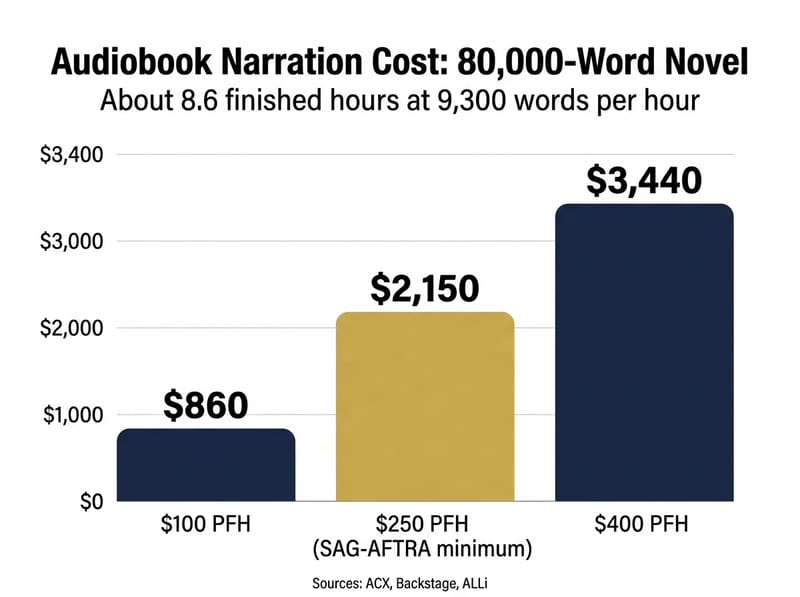
Those three numbers cover most of the market. The low end is realistic for newer narrators building their catalog. The middle is where union narrators start. The top end buys you an established voice with a following of their own.
What do audiobook narrators charge in 2026?
Narrator rates cluster into a few tiers. Here's what the sources we checked report:
- Entry level: $100 PFH, the minimum rate ACX set for its Royalty Share Plus with SAG-AFTRA contributions option||Common indie range: $100 to $250 PFH, according to Authors Republic||Beginner ACX narrators: about $200 PFH, per a narrator coach quoted by Backstage||Union narrators: $250 PFH, the SAG-AFTRA minimum on ACX reported by Backstage||Experienced professionals: $300 PFH or more, which Backstage's source called fair for proven narrators
The ALLi audiobook guide also lists studio rental at roughly $50 to $55 per hour if you record yourself in a professional booth, and DIY home equipment at about $150 to $500. One ALLi member case study reported paying £245 plus VAT per finished hour to a UK studio.
Don't forget the other line items. You'll need a square audiobook cover, a final proof listen and possibly retail-ready files for multiple stores. If you've already budgeted for professional editing, plan for the audiobook as a separate production with its own quality checks.
Should you pay upfront or choose Royalty Share?
ACX gives rights holders three ways to pay a narrator, described on its make an offer page:
- Pay for Production: you pay the producer a fee per finished hour when the audiobook is complete, and you keep all of your royalties||Royalty Share: you pay nothing upfront and split your royalties with the producer||Royalty Share Plus: a combination, where you pay a base rate per finished hour and also share royalties
Royalty Share looks free, but it isn't. Under ACX's how royalties work page, a producer on a Royalty Share title receives an equal share: 25% under the new royalty model, out of the 50% exclusive rate, or 20% under the legacy model. Producers receive those royalties for 7 years. Reedsy describes the same structure as a 50/50 split for a minimum term of 7 years.
There's a second catch. ACX's own guide notes that the Royalty Share option is only available when you grant ACX exclusive distribution, so you can't use it and also sell the audiobook through libraries or other retailers.
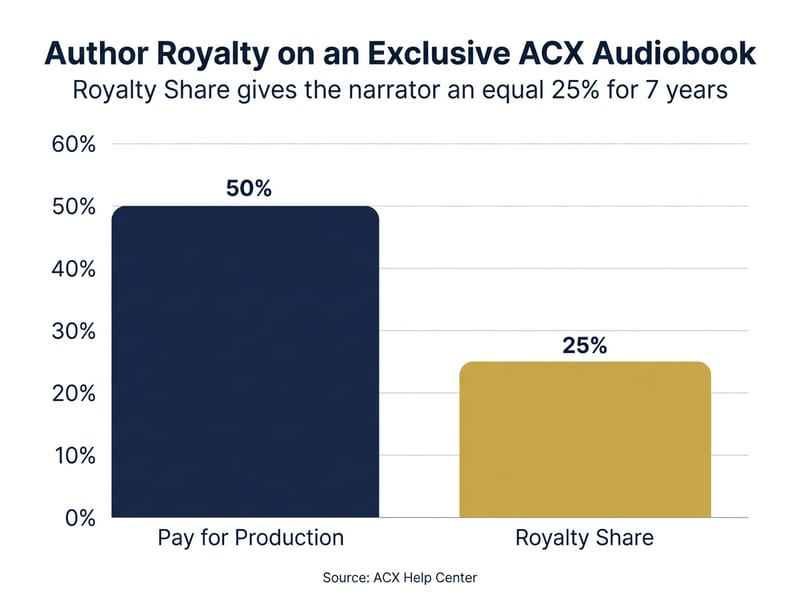
So which is better? It depends on your expected sales. If you think your audiobook will sell steadily for years, paying upfront usually wins, because every sale after you recover the fee is fully yours. If your sales are uncertain, Royalty Share protects your cash but costs you half of every sale for seven years.
A simple test: divide the upfront quote by what you'd earn per sale. That's your break-even point in units. If you're confident you'll pass that number well within seven years, Pay for Production is likely the better deal.
How does Audible's new royalty model change the math?
Audible is retiring the royalty structure indie authors have used for over a decade. According to the ACX announcement, exclusive distribution now pays 50%, up from 40% on the legacy model, and non-exclusive distribution pays 30%, up from 25%. Titles claimed after May 26, 2026 are enrolled automatically, and the legacy model will be discontinued by the end of the year.
The higher rate improves the case for paying upfront. At 50% instead of 40%, each sale recovers your production cost faster. But membership listening is now paid through a pooled Member Value system, so predicting per-unit earnings is harder than before.
We covered the full change, including the enrollment deadline, in our breakdown of Audible's new royalty model. If you have existing ACX titles, read it before the end of 2026.
Remember that you don't set your Audible price. ACX's pricing help page says Audible sets it independently, with length as one input. For example, books of 5 to 10 hours typically sell for $11.15 to $20.65, and books of 10 to 20 hours for $12.95 to $24.90.
Can you narrate your own audiobook to save money?
Yes, and many nonfiction authors do. Authors Republic says DIY production typically costs under $1,000, depending on how much equipment you already own. ALLi estimates a basic home setup at about $150 to $500, or roughly $50 to $55 per hour if you rent time in a professional studio instead.
What you save in cash, you pay in time. If professionals need 5 to 7 hours of work for every finished hour, a first-time narrator should expect more. Backstage reports that ACX narrators need about 6 to 10 hours per finished hour, so an 8.6-hour novel could mean roughly 50 to 90 hours of recording, editing and mastering before your files are ready to upload.
DIY works best in three situations:
- Nonfiction where your own expertise and voice add credibility, such as business, memoir or self-help||Short books under about 30,000 words, where the workload stays manageable||Authors with a quiet room, a decent microphone and the patience to learn basic audio editing
It works less well for multi-character fiction, where listeners expect distinct voices and accents. Whatever you choose, make sure your files meet the technical requirements of every store you plan to use, since rejected uploads cost you more time.
Which audiobook option fits your budget?
Here's how the four main paths compare for a typical 80,000-word novel:
- Free AI narration (KDP Virtual Voice or Google Play Books): $0 upfront, 40% royalty on KDP a la carte sales or a 52% revenue share on Google, limited listener demand||DIY narration: under $1,000 in equipment, plus 50 or more hours of your time, and you keep all your royalties||Royalty Share on ACX: $0 upfront, you keep 25% under the new model while the narrator receives 25% for 7 years, exclusive distribution required||Pay for Production: roughly $860 to $3,440 upfront, depending on rate, and you keep the full 50% exclusive or 30% non-exclusive rate
There's no single right answer. A debut novelist with no sales history may prefer Royalty Share to limit risk. An author whose series already sells well in Kindle Unlimited (now Kindle+ since October 22, 2026) will usually come out ahead by paying upfront and keeping every royalty.
Is free AI narration worth it?
Two major platforms now let you create an AI-narrated audiobook at no cost:
- KDP Virtual Voice: you choose a KDP ebook, pick from 80 voices and publish in minutes. KDP pays a 40% royalty on a la carte sales, and list prices must fall between $3.99 and $14.99. It's in beta in the US marketplace||Google Play Books auto-narration: Google says there's no charge, for a limited time, to create, publish and download these audiobooks. Publishers receive a 52% revenue share, and you can download the files to sell elsewhere, as long as the title is also sold on Google Play
Adoption has been fast. Publishers Marketplace reported in May 2024 that the Virtual Voice beta had already produced over 40,000 Audible titles. Details on both programs are on the KDP Virtual Voice help page and the Google Play Books auto-narration page.
The catch is listener demand. The Audio Publishers Association data tells a cautious story:
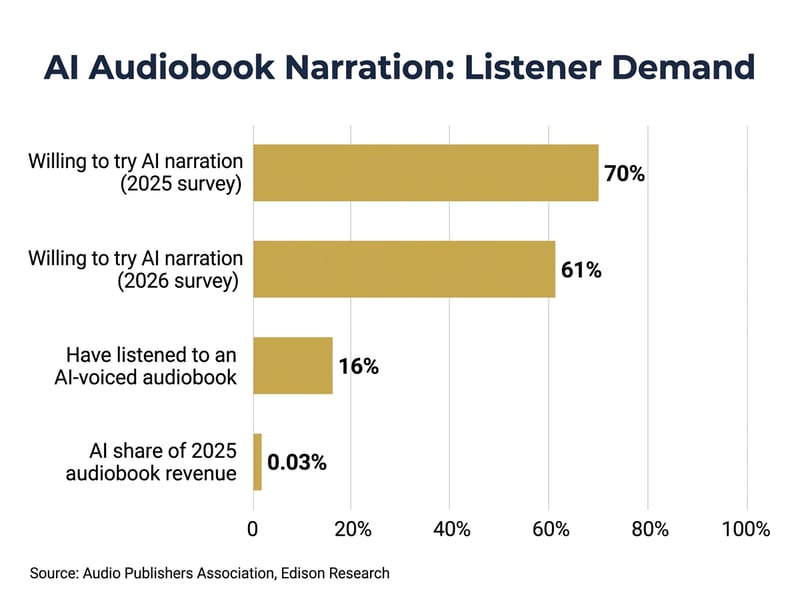
AI narration makes the most sense for nonfiction with little dialogue. Google itself says self-help, business, history and biography suit auto-narration best, while image-heavy cookbooks and textbooks are poor fits. For character-driven fiction, where listeners judge the performance, a human narrator is still the safer bet.
If you're weighing AI options beyond Amazon and Google, our report on Spotify's AI audiobook tools for indie authors covers another free route.
Is the audiobook market big enough to justify the cost?
The market keeps growing. The Audio Publishers Association reported that US audiobook sales rose 9% in 2025 to $2.43 billion. Listeners averaged 3.8 audiobooks in the past year, and 26% listened to four or more.
Competition is growing faster, though. Publishers reported over 750,000 active titles in 2025, a 43% increase from 2024. Sales grew 9% while the catalog grew 43%, which means the average title is fighting harder for attention.
For authors, that points to one conclusion: an audiobook isn't automatically profitable. It works best for books that already sell in ebook or print, especially series, where one listener can buy several titles. Genre matters too. General fiction held the largest revenue share at 27% in 2025, and sci fi and fantasy, romance and mystery rounded out the top genres.
How to budget for your first audiobook
Use this step-by-step plan to set a realistic budget before you post an audition:
- Divide your final word count by 9,300 to estimate finished hours||Choose a target rate tier: $100 to $150 PFH for newer narrators, $250 PFH for union talent, $300 PFH or more for established voices||Multiply hours by rate, then add a buffer of about 10% for pickups and cover art||Check your ebook and print sales history to estimate how many audio sales you can realistically expect||Decide on Pay for Production, Royalty Share or Royalty Share Plus based on your break-even point||Decide on exclusive or wide distribution, since Royalty Share requires ACX exclusivity||Listen carefully to the narrator's first submitted sample before approving the rest of the production
Distribution strategy matters as much as price. If you already sell wide in ebook, read our comparison of Kindle Unlimited vs going wide before you lock your audiobook into exclusivity.
Reviews matter here as well. A book with an established base of reader reviews gives an audiobook listener the same social proof it gives an ebook buyer, and it makes your production cost easier to recover. Read & Rate helps authors build that foundation with honest reader reviews on Amazon, Goodreads, Barnes & Noble and other platforms you choose, and every reviewer leaves a private comment just for you.
Frequently asked questions
Want readers lined up before your audiobook launches? Start your free Read & Rate trial to get honest reviews on the platforms you choose, connect with authors in our community hub, and run Book Biometrics on your listing.