KENP Page Reads Missing? What KDP Changed in Reports

KENP page reads missing since October 21? KDP moved Virtual Voice listening out of KENP. See where each page now shows up and how to check your Kindle+ numbers.
What happened to KENP page reads in October 2026?
The trouble started before the rebrand. Dale L. Roberts of Self-Publishing with Dale reports that starting October 21, authors saw missing Kindle Edition Normalized Pages (KENP), royalty estimates that kept moving and historical data that changed after the fact. KDP announced Kindle+ the next day, October 22, with eligible audiobooks now included in the subscription for US customers.
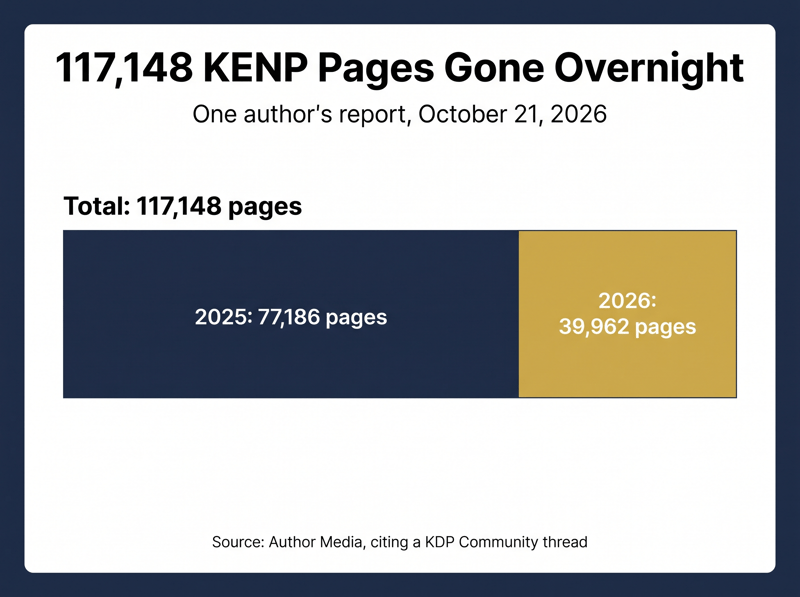
The size of the drops is what alarmed people. According to Author Media, a KDP Community thread opened October 21 described the Royalties Estimator and KENP reports as "suddenly lower by 40-50%" for the current month and for prior months. A second thread the same day reported 117,148 lifetime pages gone overnight: 77,186 from 2025 totals and 39,962 from 2026.
For an author who budgets around subscription income, a 40% swing in the estimator looks like a lost month of rent. That's why it helps to separate three different things: what you were already paid, what your reports display today, and what you will be paid for October once the fund is announced. Those three numbers can disagree for weeks without a single cent going missing, or they can reveal a real problem. You need all three to know which.
Timeline: how the KENP reporting change unfolded
- October 21: authors start reporting missing KENP, lower Royalties Estimator figures and changed history in the KDP Community forum||October 22: KDP announces that Kindle Unlimited is now Kindle+, with eligible audiobooks paid from the KDP Select Global Fund||October 29: Self-Publishing with Dale publishes its first report on the broken numbers and says KDP had not yet replied to his questions||October 31: KDP publishes a KDP Reporting Updates FAQ, according to Dale L. Roberts||November 2: Author Media publishes its roundup of community reports and notes that the wider speculation cannot be verified||November 5: Self-Publishing with Dale summarizes KDP's explanation and flags the cases it doesn't cover||Mid-November: the October KDP Select Global Fund announcement, the first official payout figure since the change
What did KDP say caused the missing page reads?
Authors who contacted KDP were pointed to the new KDP Reporting Updates FAQ. In his follow-up report, Roberts summarizes KDP's explanation in four points:
- Who was affected: the changes primarily hit authors in the Virtual Voice audiobook beta||What moved: Audible Plus listening used to be counted inside KENP pages read. KDP removed it from KENP reports, including historical data, and now reports it separately under Audible royalties||What is combined: Kindle+ pages read and pages listened now sit together in the KENP report, and you can filter them by format||What stays separate: Audible Plus royalties are not paid from the KDP Select Global Fund
KDP's own Royalties in Kindle+ help page describes the same layout. The KENP report splits Kindle+ reading and listening by format. The Prior Months' Royalties report shows one combined Kindle+ royalties column. Audible Plus listening from Virtual Voice audiobooks appears in the Audible royalties column, and royalties for ACX audiobooks stay in your ACX account.
In plain terms: if you had a Virtual Voice audiobook, some of the pages you used to see in your KENP history were never Kindle Unlimited reading at all. They were Audible Plus listens. Pulling them out makes your KENP history look smaller overnight. Whether that changes what you are actually paid is a separate question, and the answer sits in other columns, not in the KENP chart.
Does KDP's explanation cover every author?
Not clearly. Roberts writes that some authors report KENP changes without having any Virtual Voice titles. He could not verify those reports, and he says KDP's explanation "doesn't necessarily account for that situation."
Author Media is just as careful. Its write-up says speculation that page-read volume has collapsed, that the per-page rate has already changed, or that audiobooks are diluting the fund "cannot be verified from the public record." That's the honest position today: KDP has explained one cause, and nobody outside Amazon has shown whether there are others.
So treat your situation as one of two cases. If every title that lost pages has a Virtual Voice audiobook, KDP's explanation probably fits and the missing pages should reappear as Audible royalties. If titles without any audiobook lost pages, you have an open question for KDP support, and you should collect evidence before you ask it.
Where does each page and royalty show up now?
This is the part most coverage skips. After the change, a single book can earn in five different places, and only two of them live in the KENP report. Use this map before you compare one month with another:
- KENP report, Kindle+ read: ebook pages read by Kindle+ subscribers, paid from the KDP Select Global Fund||KENP report, Kindle+ listened: audiobook pages listened by US Kindle+ subscribers, paid from the same fund||Prior Months' Royalties, Kindle+ royalties column: the combined money for pages read and listened, available once the monthly fund is announced||Prior Months' Royalties, Audible royalties column: Audible Plus listening from Virtual Voice audiobooks, which used to inflate KENP||Your ACX account: royalties for ACX audiobooks, which never appear in KDP reports
One payment rule ties it together. KDP's help page says: "You're paid for the first time a subscriber reads or listens to a given page in your book." A reader who reads a page and later listens to the same page earns you one payment, not two. Our guide to what changed when Kindle Unlimited became Kindle+ covers the enrollment rules for each audiobook type in detail.
Because the Kindle+ royalties column combines reading and listening, it is the best single number to compare against past months. The KENP chart is useful for spotting trends by format, but after this migration it is no longer a like-for-like record of your history.
Were authors actually paid less?
Nobody outside Amazon can say yet. Your money for October reading depends on the October KDP Select Global Fund, and KDP says it announces "the size of the fund monthly in our community forum." The same help page warns that "Monthly KENP numbers may change and will be finalized near the 15th of the following month." October's KENP and its payout were not settled when the reports broke.
What you can measure is the trend before the change. Written Word Media tracks the US per-page payout every month. Its figures show the rate rising from $0.004221 in July 2026 to $0.005170 in August and $0.005365 in September, the highest rate so far this year. KDP's help page puts total KDP Select author earnings for September 2026 at $69.3 million.
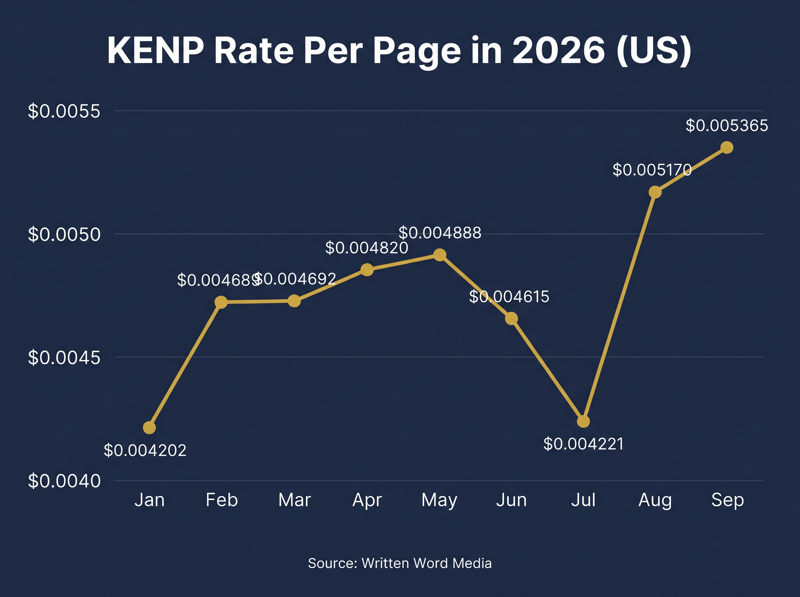
That history gives you a sanity check. In 2026 the lowest monthly rate was about 78% of the highest, so the rate alone has not moved more than roughly 22% between the best and worst month. A 40% to 50% fall in your estimate cannot be explained by the per-page rate alone. It has to come mostly from fewer pages being counted, which is exactly what the report change did for Virtual Voice authors.
How do you estimate your October Kindle+ earnings?
Until the fund is announced, any October figure is an estimate. KDP's help page says royalties for pages read and listened become available the following month, and suggests estimating with the KENP rate from the last announcement. Here's a simple way to do that without trusting a single number:
- Take your October Kindle+ read and Kindle+ listened totals from the KENP report and add them together||Multiply by the last announced US rate, $0.005365 for September 2026||Repeat with the lowest 2026 rate, $0.004202, to get a cautious floor||Compare both results with your August and September Kindle+ royalties from Prior Months' Royalties
For example, a book with 20,000 combined pages would land at about $107.30 at the September rate and about $84.04 at the January rate. Those are illustrations of the math, not a forecast: the real October rate depends on the fund size and on total pages read and listened across all of Kindle+. If your own estimate falls far below both lines while your page totals look normal, that's a sign the report, not your readership, is the problem.
How do you check your own KENP numbers?
Here's a reconciliation routine built from what KDP, Self-Publishing with Dale and Author Media recommend. Do it once now and again after the October fund is announced:
- Screenshot today's KENP report, Royalties Estimator and Prior Months' Royalties, including the Pages Listened filter, so you have a dated baseline||Download the KENP report with the Download Report button and open its KENP tab, which KDP's help page points to for detail||Filter by format and note Kindle+ read and Kindle+ listened separately for each month from July to October||Open Prior Months' Royalties and check the Audible royalties column. If you have a Virtual Voice audiobook, the pages that left KENP should show up here as money||Compare finalized statements with the payments that actually reached your bank for August and September. Money received is your ground truth||List every title with a Virtual Voice audiobook. If the drop sits only on those titles, KDP's explanation likely covers you||If titles without Virtual Voice lost pages, record the title, ASIN, month, old figure and new figure for each one
Roberts' advice on contacting KDP is blunt: use the Contact Us option in your dashboard and ask for live chat or a phone call, because "Email support is worthless in this instance." Bring your screenshots and ask one direct question, as Author Media suggests: is this a temporary reporting migration or a permanent change to what you will be paid?
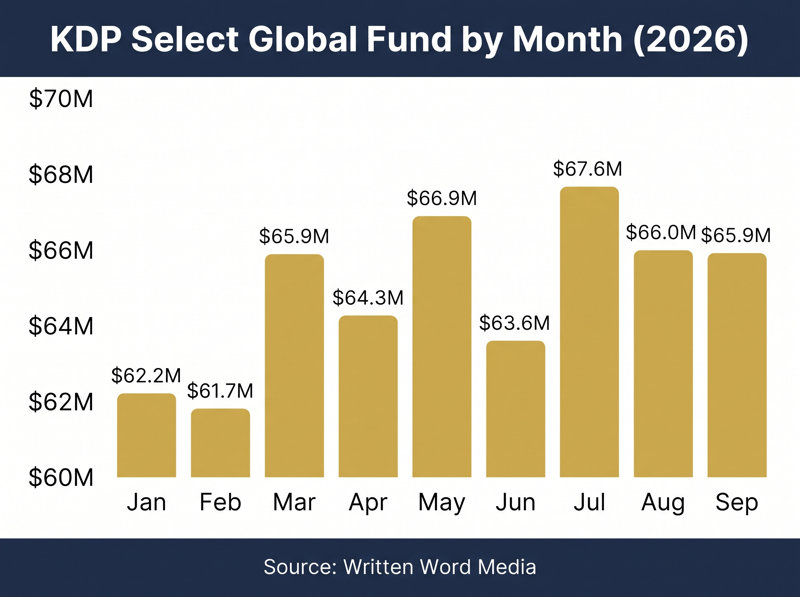
The fund itself has been steady. Written Word Media's figures show the KDP Select Global Fund between $61.7 million and $67.6 million in every month of 2026 so far, with $65.9 million in September. The open question for October is how listening, now paid from the same fund, changes the share each page earns. That answer arrives with the fund announcement, not with the estimator.
What does this mean for Virtual Voice authors?
If you have a Virtual Voice audiobook, your KDP reporting now has more moving parts than most authors'. The same title can earn from Kindle+ readers, from Kindle+ listeners and from Audible Plus listeners, and each stream appears in a different column. Your old KENP history no longer includes the Audible Plus part, so a year-over-year KENP chart will understate how your book performed in the past.
The practical fix is to stop judging Virtual Voice titles by KENP alone. Add the Kindle+ royalties column and the Audible royalties column together, month by month, and compare that total. If the total held steady through October while KENP fell, the change was cosmetic for you. If the total also fell, you have a concrete number to take to KDP.
What should Kindle+ authors do this month?
- Watch mid-November: Author Media notes the October fund announcement normally lands around mid-November. It's the first official number since the change||Track read and listened separately: if listening grows while reading falls, you'll see whether audio adds income or just moves it between formats||Keep your own rate history: a simple sheet with monthly pages, rate and payout makes the next reporting glitch easy to spot||Don't chase pages with incentives: KDP bans marketing that incentivizes Kindle+ customers, and a flagged account costs far more than one bad month||Watch signals outside KENP: reviews, sales rank and paid sales don't depend on the KENP report, so they keep telling you how a book is doing while reports settle
If you're weighing whether the subscription is still right for your catalog, our comparison of Kindle Unlimited vs going wide walks through the trade-off, and Amazon KDP royalties explained covers how sales royalties work outside Kindle+. Both still apply under the new name.
Why do audiobooks make KENP reporting harder?
Before October, KENP mostly meant ebook pages. Now one report has to hold ebook reading and audiobook listening, and Virtual Voice titles can also earn through Audible Plus, which is paid differently. Each new format adds a column, and every column is another place where a number can land in the wrong spot during a migration.
That's a strong reason to read your reports by format, not just by total. It's also why audiobook decisions now touch your ebook income. If you're planning an audiobook, see our breakdowns of audiobook production cost and Audible's royalty model for ACX authors.
At Read & Rate we see the same lesson in review data: one metric on its own can mislead you. A page-read total, a sales rank or a star average each tells only part of the story. Authors who track several signals side by side, like the ones in our Book Biometrics guide, spot a reporting glitch faster because the other numbers don't move with it.
Frequently asked questions about missing KENP page reads
Reports will settle, and the mid-November fund announcement will show whether October was a display problem or a real dip. Whatever it shows, the books that ride out these swings best are the ones readers already trust when they land on the page. Start your free Read & Rate trial to collect honest reader reviews on Amazon and the other platforms you choose, so every Kindle+ borrower and buyer sees social proof that doesn't depend on any report.