Amazon Ads for Authors: 7 Rules That Cut Wasted Spend (2026)

Amazon Ads for authors, with the 2026 math: breakeven cost per click, what the $12.99 KDP royalty change did to your margin, and when to pause a campaign.
Marketing is the part of self-publishing authors find hardest. In Written Word Media's 2025 Indie Author Survey of 1,346 authors, well over 80 percent named marketing as the most challenging aspect of being an author, ahead of both writing and production. The same survey filed Amazon Ads under mixed results, next to BookBub Ads: platforms that can work, but that authors described as hard to optimize, time consuming, and easy to overspend on without clear return.
That is an arithmetic problem before it is a platform problem. Amazon documents the mechanics openly in its author's guide to Sponsored Products, and the mechanics are not the hard part. The hard part is knowing, before you set a single bid, the most a click can cost you before the campaign starts burning money. Work that number out first and the seven rules below stop feeling like opinions. Skip it and no amount of keyword research rescues the campaign.
What changed for book advertisers in July 2026?
On 7 July 2026, Amazon raised the price ceiling for the 70 percent KDP royalty band from $9.99 to $12.99, with equivalent changes in other KDP marketplaces. Publishers Lunch reported it as the first change to that band since 2007, and the Authors Guild noted that the old $9.99 ceiling had penalized longer works, box sets, and specialized nonfiction by forcing authors either to underprice or to accept half the royalty rate.
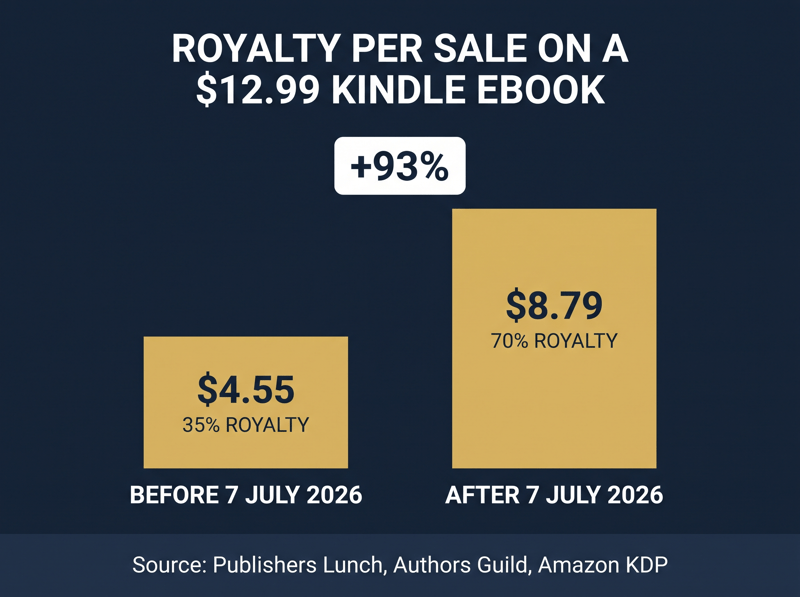
For advertisers this is not a pricing story, it is a margin story. Every extra dollar of royalty is an extra dollar of headroom in the ad auction, because the royalty is what a click has to earn back. A $12.99 ebook that previously returned $4.55 a sale at the 35 percent rate now returns roughly $8.79 at 70 percent, after the delivery cost Amazon deducts from the 70 percent option at $0.15 per megabyte in the US, about $0.30 on a typical 2 MB file. Our breakdown of how KDP royalties actually work covers those deductions in full.
What is the most you can pay for a click?
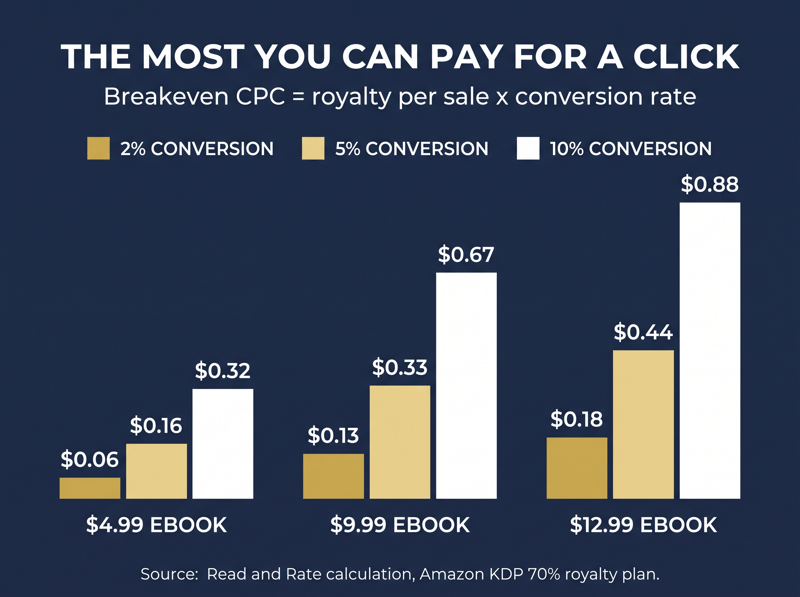
One formula answers it. Your breakeven cost per click equals your royalty per sale multiplied by your conversion rate. If a click earns you $3.19 when it converts, and one click in twenty converts, each click is worth $0.16 on average. Pay more than that and the campaign loses money on every auction it wins, no matter how good the click through rate looks.
Ebook list priceRoyalty per saleBreakeven CPC at 2%at 5%at 10%$4.99$3.19$0.06$0.16$0.32$9.99$6.69$0.13$0.33$0.67$12.99$8.79$0.18$0.44$0.88
Royalties above assume the 70 percent plan on the US store and a 2 MB file. Find your own row before you take anyone's advice about bids, because a $2.99 ebook and a $12.99 ebook are not playing the same game, and neither is a page that converts at 2 percent against one that converts at 10 percent. Two caveats matter. Kindle Unlimited page reads never appear in reported ACOS, so books enrolled in KU earn more than the dashboard admits. And series read-through means book one can run at a planned loss when books two and three collect the profit, which is exactly why series authors can outbid standalone authors on the same keyword and still come out ahead.
The 7 rules that cut wasted Amazon Ads spend
With your breakeven click price written down, the rest is discipline. Each rule below closes one specific leak, and they are ordered the way you should apply them: account setup, campaign type, funding, targeting, exclusions, pruning, and finally the page the click lands on.
Rule 1: Register as an author, not a seller
Amazon Ads runs in its own console, separate from KDP, and the registration path matters. Amazon's guidance is to select the Amazon Author option during registration, and your titles must be claimed in Author Central before you can advertise them. Get this right and one campaign reaches three surfaces: your ads can appear in shopping results and on book detail pages across Amazon, Kindle, and Goodreads. Get it wrong and you spend an afternoon in a seller onboarding flow built for someone shipping physical inventory.
Rule 2: Start with Sponsored Products, and run auto beside manual
Sponsored Products is the format to learn first, because it puts your cover in front of readers who are already shopping for a book. Run an automatic campaign and a manual campaign at the same time rather than choosing between them. Automatic targeting lets Amazon surface search terms you would never have guessed, and the search term report tells you which of those terms actually converted. Manual targeting then takes those proven winners and bids on them deliberately. The automatic campaign is your research budget; the manual campaign is where the research gets spent.
Rule 3: Fund the campaign properly or do not run it
Starving a campaign feels prudent and is not. As Amazon's budget guide explains, daily budgets are spent as fast as impressions become available, so a small budget can be gone in minutes and your ads sit ineligible until midnight. Amazon recommends a minimum of around $10 a day per campaign for many advertisers, and averages that daily budget across the calendar month, so $10 a day caps at $300 a month even though a single busy day might reach $12.50. Writing for Reedsy, Amazon advertising specialist Laura Russom puts the trap plainly: on low budgets you do not overspend, you undersell. Set the budget at a level you can genuinely sustain, then let bids and targeting do the controlling.
Rule 4: Target precise phrases, not category labels
Broad category words attract clicks from readers who are still browsing. Specific phrases attract readers who have already decided what they want. Russom's example is worth memorizing: leadership book looks like the obvious keyword and performs worse than books for new managers, because the second phrase describes a reader with a problem. The same logic applies to fiction, where cozy small town mystery with recipes will out-convert mystery series every time. If you are not sure which phrases describe your book, the research you did for KDP keywords and categories is the same research, and your seven backend keyword slots are a reasonable starting list.
Rule 5: Add negative targets before you need them
Negative targeting tells Amazon which searches should never trigger your ad, and most authors only discover it after paying for a month of irrelevant clicks. Amazon's own example is an urban fantasy author excluding high fantasy and epic fantasy so their ads stop reaching readers who want medieval settings. Build a starting list on day one rather than day thirty:
- Formats you do not sell, such as audiobook or hardcover, if you are advertising an ebook only||Adjacent subgenres that share your vocabulary but not your reader, the urban fantasy against high fantasy problem||Free and discount intent words when your book is not priced to match them||Author names and series titles you are clearly not comparable to, which drain budget on curiosity clicks||Age brackets you do not write for, so an adult thriller stops paying for young adult searches
Rule 6: Kill losing targets on a click threshold, not a feeling
Decide the rule before you are emotionally invested in a keyword. A target that has taken real clicks without a single order is not unlucky, it is mismatched, and every further click confirms it more expensively. The threshold should be set in clicks rather than days, because a keyword with four clicks in three weeks has not been tested and a keyword with forty clicks in three days has been tested thoroughly.
Rule 7: Fix the detail page before you raise the bid
Notice what Amazon tells advertisers to do when a campaign spends its budget without converting. The advice is to optimize bidding, targeting, and the product detail page, and the third item is the one authors skip. A click is a reader arriving at your page; the page decides whether they buy. That is your cover, your book description, your price, your Look Inside sample, and your reviews. Raising a bid on a page that converts at 1 percent simply buys more expensive proof that the page converts at 1 percent.
How much do authors at your stage actually spend?
Ad budgets tend to be set by anxiety rather than benchmark. The Written Word Media survey gives you a real reference point: average monthly marketing spend was $636 across all 1,346 respondents, but that average hides a steep ladder. Authors earning under $100 a month spend about $81 on marketing. Authors earning $1,000 to $5,000 spend about $478. Authors earning over $10,000 spend about $4,500.
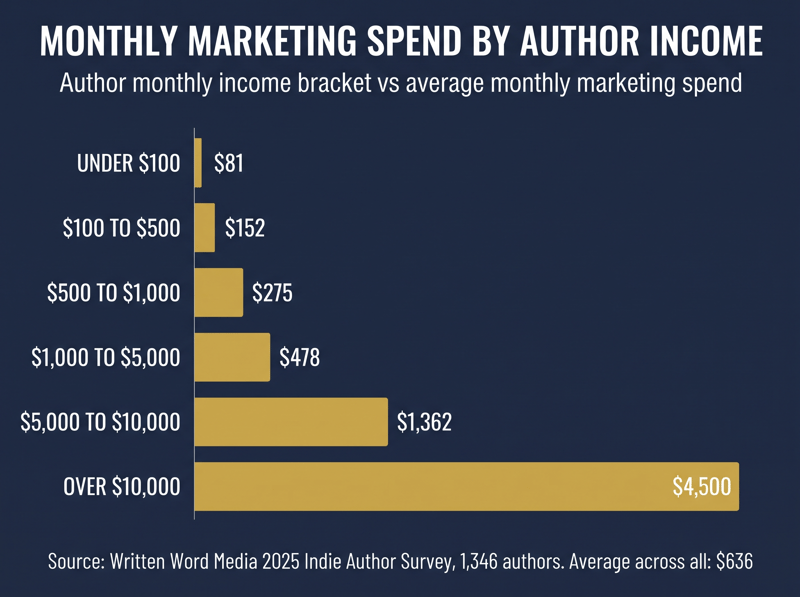
Read that ladder in the right direction. Higher earners are not rich because they spend more; they spend more because a tested campaign earns it back and the reinvestment is safe. If you are in the lower brackets, the survey does not tell you to spend $4,500. It tells you that $80 to $150 a month is what your peers are working with, which at a $0.16 breakeven click price buys roughly 500 to 900 clicks a month of learning. That is enough to find your converting keywords, and not enough to lose money you needed.
Which numbers should you check each week?
Amazon hands you more data than any author needs, and the temptation is to watch the dashboard daily and change nothing usefully. Four signals carry almost all the information, and they diagnose different failures. Read them in order, because each one only makes sense if the one above it is healthy.
- Impressions: are your ads being served at all? Falling impressions usually mean your bid lost the auction or your budget ran out early, not that readers stopped searching||Click through rate: is the cover and title earning the click? A weak CTR is a creative and targeting problem, and no bid increase fixes it||Conversion rate: are clicks becoming sales? This is a detail page problem, and it is measured against the breakeven table above||ACOS or ROAS: is the whole thing profitable? Compare it to your own breakeven, not to a number from a blog post, and remember it excludes Kindle Unlimited page reads
Amazon also flags something authors rarely connect to advertising. In its guidance on measuring ad success, it lists customer reviews as a retail metric that advertising can lift, on the reasoning that more reviews build social proof for future readers. The relationship runs both ways, and the second direction is the one that costs you money: a detail page with four reviews converts worse than the same page with forty, so the same click costs you more per sale.
When should you not run Amazon Ads at all?
Advertising multiplies whatever your listing already does. If the listing converts, ads scale it. If the listing does not convert, ads scale the failure and charge you per impression for the privilege. Hold the budget until all of the following are true:
- Your cover signals the right genre at thumbnail size. Written Word Media respondents rated cover design the single most important factor in selling a book||Your description sells rather than summarizes, because that is the page a paid click lands on||Your price sits inside a royalty band you have deliberately chosen, not one you inherited at publication||You have enough reviews that a stranger will take the risk on you||You know your breakeven cost per click and have written it down
The last two are the ones authors postpone. Reviews in particular are treated as something that happens later, when they are the input that decides what every future click costs. Our data on how many reviews a book needs to sell covers the thresholds, and the guide to getting Amazon reviews covers the mechanics without breaking Amazon's rules.
Frequently asked questions
Ads amplify a page that already converts
Every rule above points at the same place. The auction sets what a click costs, but your royalty and your conversion rate decide what a click is worth, and only one of those two is under your control this week. Raising conversion from 2 percent to 5 percent multiplies your affordable bid by two and a half without touching a single campaign setting. That is why the cheapest advertising work happens on the detail page, before any money reaches Amazon.
Reviews are the part of that page you cannot write yourself, and they are the part Amazon names as a metric advertising can move. Read and Rate exists for that step. You list your book, real readers choose it themselves, every download is watermarked to the reader who took it, you pick which platforms you want reviews on rather than being locked to Amazon alone, and each reviewer can leave you private feedback that no one else sees. Build the review base first, then let your ads buy clicks that a stranger is willing to act on.