Email List Building for Authors: 7 Proven Steps (2026)

Email list building for authors in 7 proven steps: pick a platform, create a reader magnet, write a welcome sequence, and turn subscribers into book buyers.
Why does an email list matter more than social media?
In Written Word Media’s 2025 author survey, authors earning more than $10,000 a month rated their own newsletter 4.3 out of 5 for effectiveness. Authors earning $100 or less a month rated it about 2.7. The same survey ranked an author’s own email list as the most effective marketing tactic, ahead of promo sites, Facebook ads and BookBub deals.
That is a correlation, not proof that a list causes higher income. Still, the pattern is consistent: authors who sell well tend to treat their list as a core business asset, not an afterthought.
The deeper reason is ownership. TikTok, Instagram and Facebook can change their reach overnight. Your list moves with you to any platform, any retailer and any future book. If you are already building visibility on short video, our guide to BookTok for indie authors explains why every viewer should get a reason to subscribe.
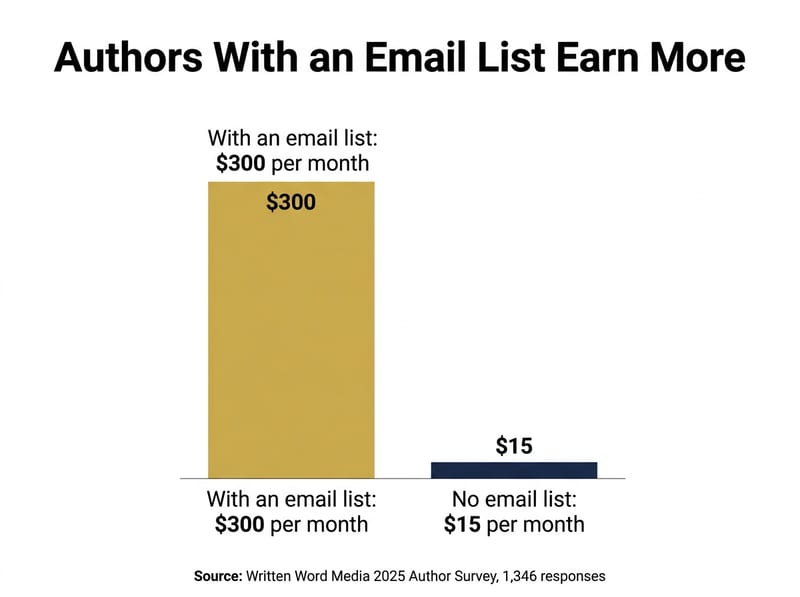
Engagement tells the same story. A Written Word Media guide estimates that 30 to 50 of every 100 subscribers will open a given email, while only 6 to 10 of every 100 social followers see a given post. Email puts your news in front of several times more of the people who asked to hear from you.
Step 1: Which email platform should an author choose in 2026?
Start with a platform that has a free tier and grows with you. You do not need advanced automation on day one, but you do need a sign-up form, a landing page and at least one automated welcome email.
Pricing changed this year, so check current limits before you commit. On June 16, 2026, MailerLite cut its free plan from 500 to 250 active subscribers and from 12,000 to 2,500 monthly emails, according to MailerLite’s free plan update FAQ. That is still enough to test a reader magnet, but a growing list will reach the paid tier quickly.
Kit (formerly ConvertKit) moved in the other direction. Email Vendor Selection’s August 2026 pricing review reports that Kit’s free Newsletter plan covers up to 10,000 subscribers, and its Creator plan starts at $39 a month for 1,000 subscribers if you want automated sequences.
How to compare platforms quickly
- Free tier size: how many subscribers can you hold before paying?||Automation: can you send a welcome sequence without upgrading?||Integrations: does it connect to BookFunnel or StoryOrigin for reader magnet delivery?||Landing pages: can you build a sign-up page without a separate website?||Export: can you download your full list as a CSV at any time?
The last point matters most. Whichever tool you pick, make sure you can export your subscribers in one click. That keeps the list yours, not the platform’s.
Step 2: What is a reader magnet and how do you create one?
A reader magnet is a free piece of content you give in exchange for an email address. For fiction, the strongest options are a prequel novella, a bonus epilogue, a short story set in your world or the first book of a series. For nonfiction, think checklists, templates, a workbook or a sample chapter with extra material.
The magnet must match the book you want subscribers to buy next. A romance reader who joins for a bonus epilogue is a strong lead for the next romance. A random freebie in an unrelated genre attracts people who will never open your launch email.
How reader magnets are delivered
Most authors use a delivery service rather than attaching files to emails. According to ScribeCount’s BookFunnel overview, BookFunnel’s First-Time Author plan costs $20 a year, the Mid-List Author plan costs $100 a year and the BestSeller plan costs $250 a year. Mailing list integrations, which add new readers to your email platform automatically, start at the Mid-List tier.
If you share PDF files directly, protect them. Read & Rate automatically watermarks every downloaded PDF with the downloader’s email address, which discourages casual sharing. Our guide on book piracy protection for indie authors covers more ways to keep free copies from spreading.
Step 3: How do you write a welcome sequence that keeps readers?
The first email a subscriber receives sets the tone for every email after it. Written Word Media’s email marketing guide for authors recommends that your welcome email include four things: a thank you, a short personal introduction, the promised gift and links to where readers can follow you.
A short automated sequence of three to five emails over the first two weeks works well for most authors. It turns a stranger who wanted a free story into a reader who knows who you are and what you write.
- Email 1 (immediately): thank them, deliver the reader magnet and say what to expect from your newsletter||Email 2 (day 2 or 3): tell the story behind your book or series and why you write in this genre||Email 3 (day 5 to 7): ask a simple question they can reply to, such as their favorite trope or what they are reading||Email 4 (day 9 to 11): introduce your first full book with a direct buy link||Email 5 (day 14): invite them to join your ARC team or review the book they just read
Replies to Email 3 do two jobs. They tell you what your readers want, and they start a real conversation that makes readers more likely to open your next email.
Step 4: Where should authors promote their sign-up link?
The highest-converting spot is usually the back of your own book. A reader who just finished your story is at peak interest. Place a short, specific offer right after the final chapter, before the acknowledgments, with a direct link to your landing page.
Then repeat the link everywhere readers find you. Each channel below brings a different type of subscriber.
- Back matter of every ebook and a short URL or QR code in every paperback||Your author website, as a pinned offer on the home page rather than a footer form||Your bio link on TikTok, Instagram and Threads||Your Amazon Author Central biography and your Goodreads author profile||Group promotions and newsletter swaps with authors in your genre||Your author profile and book pages on Read & Rate, which are public and indexed
Read & Rate includes a free QR code generator, which makes it easy to put a scannable sign-up link inside print editions and on bookmarks or event banners.
Step 5: How often should authors send newsletters?
Consistency beats volume. Written Word Media recommends starting with 1 to 3 emails a month, noting that this range tends to give the highest engagement with the lowest reader fatigue. The same guide cites a HubSpot figure that 69% of people unsubscribe because they receive too many emails.
A simple monthly rhythm is enough for most authors: one news email with a writing update and a recommendation, plus an extra email in any month when you have a launch, a price promotion or a preorder going live.
What to put in a regular author newsletter
- A short personal update: what you are writing, editing or researching||Behind the scenes content: a deleted scene, a character note, a cover reveal||One clear call to action: buy, preorder, review or reply||A recommendation of another author’s book in your genre
Keep subject lines under 60 characters, as Written Word Media advises, and make each email focused on a single action. If you are planning a release, our article on KDP pre-orders after the September 2026 update explains how to time a preorder email for maximum impact.
Step 6: What open and click rates should authors expect?
MailerLite’s 2025 email marketing benchmarks, based on more than 3.6 million campaigns from 181,000 accounts sent between December 2024 and November 2025, show an average open rate of 43.46% and a click rate of 2.09% across all industries.
For the Author category specifically, MailerLite reports a 43.14% open rate, a 2.75% click rate and a 0.31% unsubscribe rate. In other words, author newsletters get more clicks than the average sender, which makes sense: readers who opt in want to know about your next book.
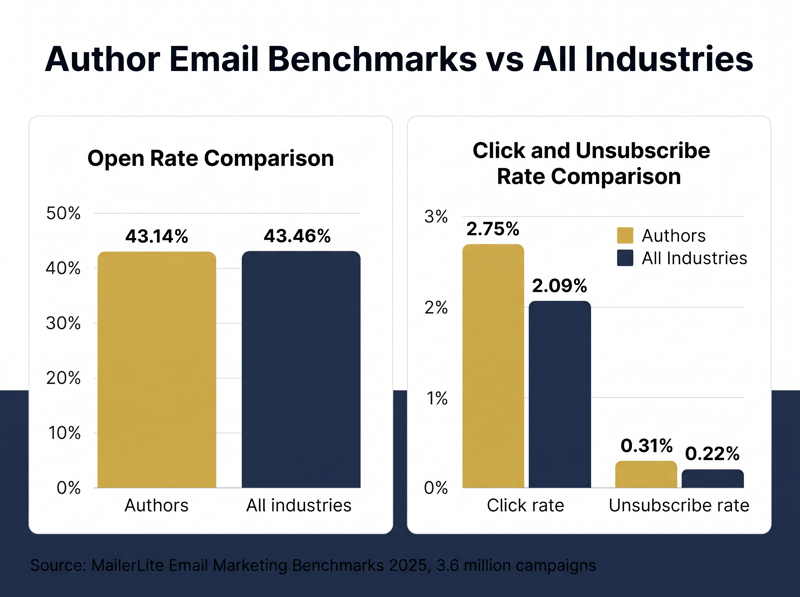
Use these numbers as a health check, not a target to obsess over. Privacy features in some email apps can inflate open rates, so clicks and sales are more reliable signals.
Written Word Media suggests keeping your unsubscribe rate well below 0.5% per email and expecting zero spam complaints on small lists. If you see complaints, check that every subscriber actually opted in and that your emails match what your sign-up form promised.
How to clean a list without losing real readers
- Every 3 to 6 months, tag subscribers who have not opened or clicked in the last 90 days||Send that group a short re-engagement email asking if they still want to hear from you||Remove anyone who does not respond, which protects your deliverability and lowers costs
Step 7: How do you turn subscribers into reviews and sales?
A list only pays off when you ask it to do something. The two most valuable actions for a self-published author are buying a new release in its first week and leaving an honest review shortly after.
Build an ARC team from inside your list. Invite your most engaged subscribers to receive an advance copy in exchange for an honest review, and explain clearly that the review must reflect their real opinion. Our guide to ARC book reviews for self-published authors explains how to run this without breaking retailer rules.
Never offer gifts, discounts or entries in a draw in exchange for positive reviews. Amazon’s rules treat incentivized reviews as manipulation, and a review purge can wipe out months of work.
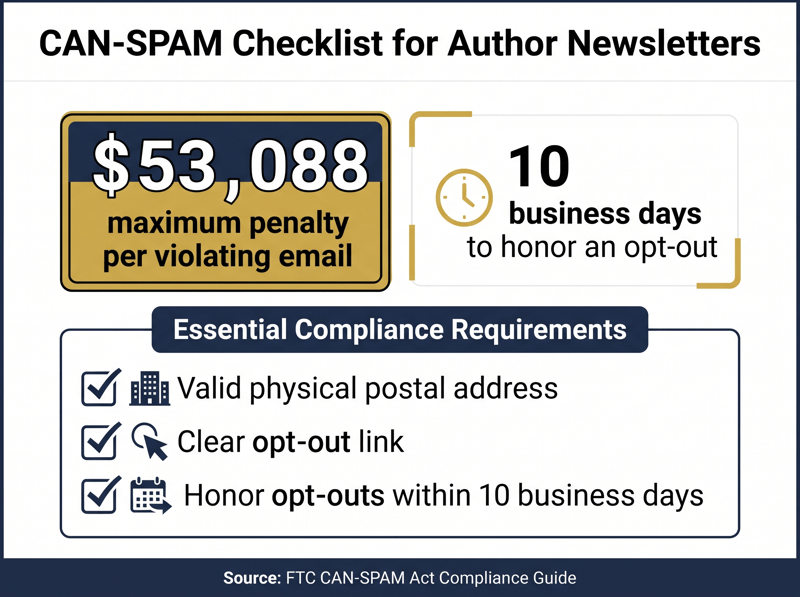
Read more in the FTC’s CAN-SPAM compliance guide. Your email platform handles the unsubscribe link and address footer automatically, but you are still responsible for using it correctly. If you do not want to show a home address, a PO box or a registered mailbox service is a common choice for authors.
How fast can a new author grow an email list?
Growth depends on your genre, your reader magnet and how many readers already find your books. There is no reliable industry figure for an average growth rate, so be wary of anyone promising a specific number of subscribers in 30 days.
What you can control is the number of places where readers meet your offer. Authors who combine back matter links, a strong genre-matched magnet and occasional group promotions usually grow faster than authors who rely on a single form on their website.
Track three numbers each month: new subscribers, the share of subscribers who click, and the sales or reviews that follow a send. Read & Rate’s Book Biometrics tool analyzes your cover, title, description and A+ Content, so you can make sure the page your emails send readers to is ready to convert. See our guide to Book Biometrics metrics for more detail.
What mistakes slow down author list building?
- Waiting until launch week to start a list, when it is too late to build momentum||Offering a reader magnet that does not match the books you sell||Sending nothing for months, then emailing only when you want a sale||Using a no-reply address, which blocks replies and conversations||Hiding the sign-up link at the bottom of your website||Adding readers without permission, which risks spam complaints and legal penalties
None of these mistakes are permanent. Fix the biggest one first, usually the reader magnet or the placement of your link, and track the difference over the next month.
Your email list grows fastest when every book you publish works as a sign-up page. Read & Rate helps you get the honest early reviews that make those readers trust your next book, with a community of authors exchanging feedback, multi-platform review links and watermarked PDF delivery built in.