Kindle+ Payout October 2026: $71.1M in First Audio Month

Kindle+ paid authors $71.1M for October 2026, its first month with audiobooks. See the $67.7M fund, the missing per-page rate and how to check your payout.
This is the number many authors were waiting for. After KENP reports were rebuilt in late October, which we covered in our guide to missing KENP page reads, the October fund announcement was the first official figure since Kindle Unlimited became Kindle+. Author Media had flagged it in advance, writing that the October figure, normally released around mid-November, "will be the first official data point." Here is what it says, and what it still doesn't tell you.
What did KDP announce for October 2026?
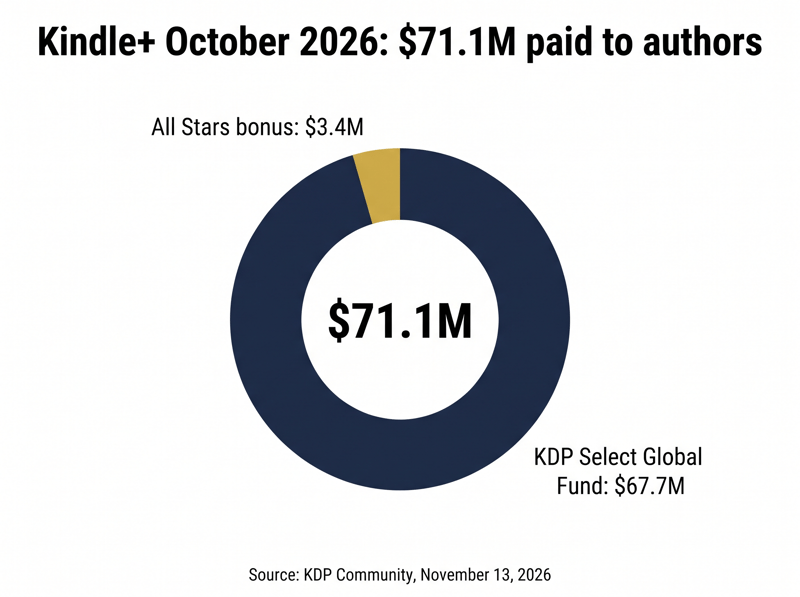
KDP posted its monthly update, titled "KDP Select Global Fund and All Stars Bonus Update, October 2026," in the KDP Community forum on November 13, 2026, as reproduced by the Releasebot Amazon release feed. The headline line reads: "For October 2026, KDP authors earned $71.1 million from Kindle+." The same $71.1 million now appears in the "Total KDP Select Author Earnings" banner on KDP's official Kindle+ help page.
KDP also said it is "increasing our investment in the KDP Select Global Fund to support authors during the launch." That matches what Amazon told authors on launch day, when Written Word Media reported that Amazon was "investing additional funds" in the fund to cover audiobook listening.
- Total Kindle+ earnings: $71.1 million for October 2026||KDP Select Global Fund: $67.7 million, shared by pages read and pages listened||All Stars bonus: $3.4 million for top titles and authors||New report column: total Kindle+ earnings now sit in the "Kindle+ Royalties" column of the Prior Months' Royalties report, and payments show the source "Kindle+ Royalties"||Audible royalties: Audible Plus listening of Virtual Voice audiobooks now appears in a separate "Audible royalties" column, paid as source "Audible Royalties"
Note what is missing. The announcement gives no per-page rate for ebooks, no separate rate for listening and no split between the two formats. KDP's Royalties in Kindle+ help page explains why: your earnings are "based on your share of total pages read or listened to by Kindle+ subscribers," and the share of the fund given to each country varies with exchange rates, reading and listening behavior and local subscription pricing. The per-page figure authors quote every month has always been calculated by third parties, not published by Amazon.
How does the October fund compare with earlier months?
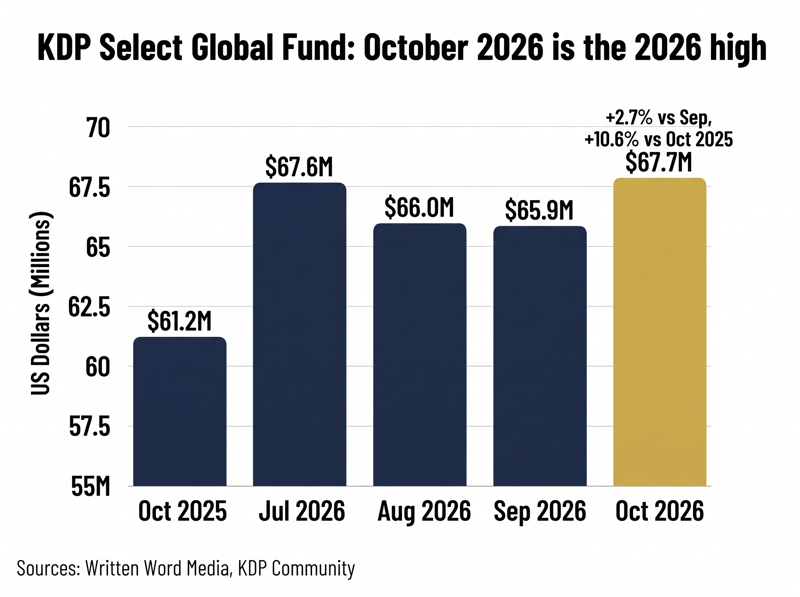
On the raw fund, October is a record for 2026. Written Word Media's fund tracker shows the monthly KDP Select Global Fund between $61.7 million and $67.6 million from January to September 2026, with $65.9 million in September. October's $67.7 million edges past July's $67.6 million to become the highest month of the year so far.
The total picture moves in the same direction. KDP's Royalties in Kindle+ page still showed September 2026 total KDP Select author earnings of $69.3 million when we checked it, against $71.1 million for October. That is an increase of $1.8 million, or about 2.6%.
Year over year, the jump is bigger. Written Word Media lists the October 2025 fund at $61.2 million. October 2026's $67.7 million is about 10.6% higher. The fund has grown steadily for two years, and the Kindle+ launch added another step on top.
A bigger fund is good news, but it isn't the whole story. Until September, the fund paid for one thing: ebook pages read. From October 21, 2026, when audiobooks entered Kindle+ according to KDP's Reporting Updates FAQ, the same fund also pays for pages listened. A 2.7% raise split across two formats is not the same as a 2.7% raise for ebooks.
Why didn't KDP publish a per-page rate?
KDP has never published one. The per-page numbers you see in author groups come from trackers such as Written Word Media, whose team has noted that "the per page payout isn't listed by Amazon" and that its figures reflect only the US market. Those trackers work the rate out from author reports after the fund is announced, so an October rate usually appears a few days after the fund itself.
Kindle+ makes that work harder. Written Word Media's launch coverage says Amazon "has not announced specific per-format payment rates," and KDP's help page adds one more rule: with Immersive Reading, where a subscriber reads and listens at the same time, "you earn at the higher rate." That sentence only makes sense if reading and listening can pay different rates. So when a tracker publishes an October number, ask which format it measures before you plug it into your spreadsheet.
Will audiobooks lower the KENP rate for ebook authors?
Nobody outside Amazon can answer that yet, but you can see the break-even point. The September US rate, per Written Word Media, was $0.005365 per page, the highest of 2026. If the US pool of paid pages had stayed flat while the fund grew 2.7%, the rate would rise to roughly $0.0055. Every extra page of listening pushes it back down. The table below is our own illustration, built only from the two published fund figures and the September rate, and it assumes the US share of the fund moved in line with the total.
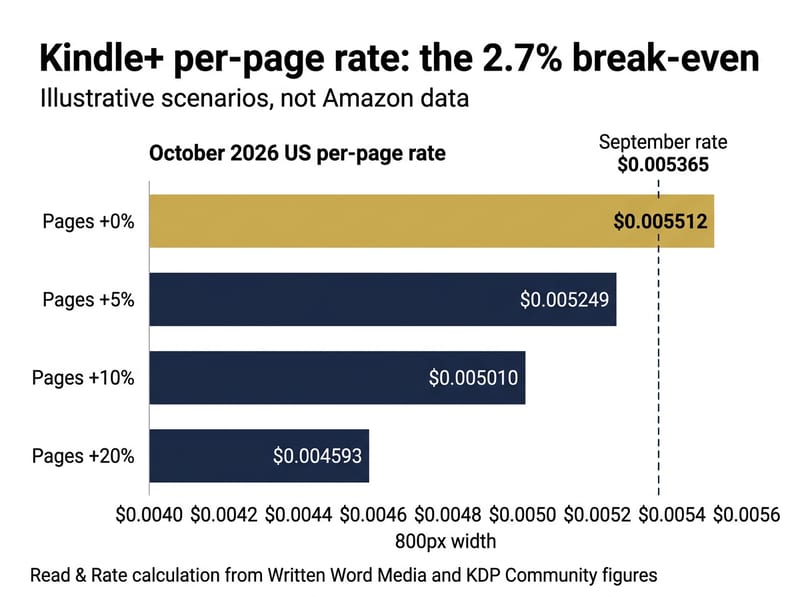
Read the table as a range, not a forecast. Even the 20% scenario lands at about $0.0046 per page, close to where the rate sat in mid-2026: Written Word Media lists $0.004615 for June and $0.004221 for July. In other words, the plausible outcomes for October sit inside the band authors already lived through this year. What changes is who earns the money.
- Ebook-only authors: if listening grew fast, your share of the fund can shrink even when your own pages hold steady||Authors with Virtual Voice or eligible ACX audiobooks: listening pages add to your share, so a lower rate can still mean a higher total||Authors with both formats on the same title: KDP pays only "the first time a subscriber reads or listens to a given page," so a reader who switches format mid-book doesn't pay you twice
That last rule matters more than it looks. Many readers who start a novel on a Kindle and finish it in the car will now do it inside one subscription. You get paid for each page once, whichever format it was consumed in. For the full mechanics of the subscription and how it compares with selling everywhere, see Kindle Unlimited vs going wide; the trade-offs still apply under the Kindle+ name.
How do you calculate your October Kindle+ royalties?
Your actual October money is already decided. It depends on your share of all pages read and listened in each marketplace, and KDP says royalty estimates become available "when the KDP Select Global Fund is announced." Since the fund is now out, your reports should start to show final October figures. Here is how to read them without being misled by the reporting changes.
- Open the Prior Months' Royalties report and find the "Kindle+ royalties" column for October 2026. This one number combines pages read and pages listened||Open the KENP report and filter by format. Note your Kindle+ read pages and Kindle+ listened pages separately||Divide your Kindle+ royalties for the US marketplace by your combined US pages. That gives your own effective October rate, which is more useful than any tracker's average||Repeat for September using the same column, so you compare like with like||If you have Virtual Voice audiobooks, add the separate "Audible royalties" column, which now includes Audible Plus listening that used to sit inside subscription royalties||Screenshot everything with the date visible. If a figure moves later, you have a baseline to show KDP support
Step three is the angle most coverage misses. Every author's effective rate is slightly different because the fund is split by marketplace, and your mix of readers in the US, UK, Germany or Japan shapes your number. Kindle+ runs in 12 marketplaces, according to the KDP Select page: the U.S., U.K., Germany, Italy, Spain, France, Brazil, Mexico, Canada, India, Japan and Australia. Audiobook listening, though, is US only for now. So if most of your readers are outside the US, the audiobook question barely touches you this month.
A quick sanity check helps too. If your combined October pages were 20,000 in the US, the illustrative rates above put your October Kindle+ money between about $91.86 (at $0.004593) and $110.24 (at $0.005512). If your report shows something far outside that range for the same pages, look again at which columns and formats you are adding up.
What changed in Amazon Ads reporting for KENP?
The fund was not the only change this week. On November 11, 2026, Amazon Ads updated its help page on KENP metrics, and PPC Land reported on November 12 that the page now states: "Estimated KENP royalties metrics are no longer available in Reporting." If you run ads and used that column to judge whether a campaign paid for itself through page reads, it is gone.
- What replaced it: KENP read, qualified borrows and estimated royalties based on borrows, still labeled with the old Kindle Unlimited name inside Amazon Ads||How results are split: by clicks and views, and by promoted and halo books||Attribution window: 14 days after a click, and offline reads can take up to a week to report||What is still unclear: PPC Land notes the page does not define a qualified borrow, gives no page threshold and does not explain the royalty method
The practical effect: your ad dashboard and your KDP dashboard now measure Kindle+ income in different ways. Ads estimates from borrows. KDP pays on pages read or listened. Don't expect them to match, and judge campaigns over several weeks of KDP royalties rather than a single ads column. Our guide to Amazon Ads for authors covers how to set a break-even ad budget when part of your income arrives through page reads.
Which audiobooks earn from the Kindle+ fund?
Only some audiobooks share the $67.7 million. KDP's Kindle+ help page says "Audiobooks in Kindle+ are available for distribution in the US marketplace only at this time." Virtual Voice audiobooks join automatically when their ebook is in KDP Select, and they cannot be removed separately. ACX audiobooks are stricter. Written Word Media lists four launch conditions:
- The ebook is enrolled in KDP Select||The audiobook is distributed exclusively through Audible and ACX||Whispersync for Voice is enabled||The audiobook was made under Pay for Production, because Royalty Share and Royalty Share Plus titles are not eligible at launch
Unlike Virtual Voice titles, eligible ACX audiobooks can be taken out of KDP Select separately from the ebook, according to KDP's Royalties in Kindle+ page. If you are weighing whether your ACX title belongs in the fund or on Audible's own terms, compare it with our breakdown of Audible's new royalty model for ACX authors, and remember that the per-page listening rate is still unpublished. If you are thinking about producing a first audiobook just for Kindle+, our guide to audiobook production cost shows what the different routes cost.
What should Kindle+ authors do in November?
- Record your October baseline now: Kindle+ royalties, pages read, pages listened and Audible royalties, by marketplace||Wait for the October rate from trackers, then check which format it measures before comparing it with September's $0.005365||Compare totals, not charts: Author Media reported KENP and Royalties Estimator drops of 40 to 50% after the October migration, so the KENP chart is not a like-for-like history||Review ad reporting: rebuild any spreadsheet that relied on the removed "Estimated KENP royalties" column||Decide on audio with data: if you add a Virtual Voice or ACX title, track its listened pages for at least two full months before judging it||Keep promoting the ebook: page reads still drive most Kindle+ income, and the fund rewards titles readers finish
The November fund, due around mid-December, will be the first full month with audiobooks in Kindle+ from day one. October only had audio from October 21, so its numbers reflect about 11 days of listening. Treat October as a partial reading and November as the real test of how much listening changes the pool.
Why do reviews matter more in a shared fund?
A per-page model has one simple rule: you only earn when a subscriber keeps going. Kindle+ makes it cheap to try a book as an ebook or an audiobook, and equally cheap to abandon it. What makes a subscriber press "Read for free" or "Listen for free" and then stay to the last page is trust, and on Amazon that trust starts with reviews and ratings on the product page.
That is also why a shared fund rewards titles that get discovered early. A book with honest reviews from real readers converts more browsers into borrowers, and more borrowers into finished pages. If your new release is going into Kindle+, build that proof before launch week, not after. Our data on how many reviews a book needs shows where the conversion jumps happen, and ARC reviews are the fastest way to get there.
At Read & Rate, reviewers request a watermarked copy of your book, read it and leave honest reviews on the Amazon marketplace you choose, plus Goodreads, Barnes & Noble, Apple Books and other platforms, with a private note for you alone. It's a community of authors helping each other, and it works the same whether your readers find you through a sale, a borrow or a listen.
Frequently asked questions about the October Kindle+ payout
October's payout is a solid number with a big asterisk: more money, more formats sharing it, and no official rate. The authors who come through this transition best will be the ones tracking their own effective rate, not the headlines, and the ones whose books readers trust enough to finish. Start your free Read & Rate trial and collect honest reviews from real readers before your next Kindle+ launch.