Get Books Reviewed Alternatives: 7 Platforms (2026)

Compare 7 Get Books Reviewed alternatives for 2026 with verified pricing, Trustpilot ratings, Amazon review rules, and the best fit for your book and budget.
What is Get Books Reviewed and how does it work?
Get Books Reviewed describes itself as a private community where authors review each other's Kindle books. It says it is not a review swap service: its algorithm is designed so that two authors never directly review each other's books. Instead, you review titles from a shared library, earn tokens, and spend those tokens to have other members review your book.
The site is clear about its focus. It states that all Kindle book reviews are published on Amazon, that about 99 percent of members are based in the US, and that reviews posted on other marketplaces are of no use to its members. International authors are told to make sure their reviews can appear on Amazon's US store.
Membership is sold monthly or annually. The annual plan is listed at $180, and both plans include a 10-day free trial you can cancel at any time. Reviewers can send private, one-way feedback through the portal and stay anonymous unless they choose to share their name. The site also notes that reviews can take 1 to 10 days to show up on Amazon, and that a purchased book only counts as a verified review when the review is posted from the digital orders page.
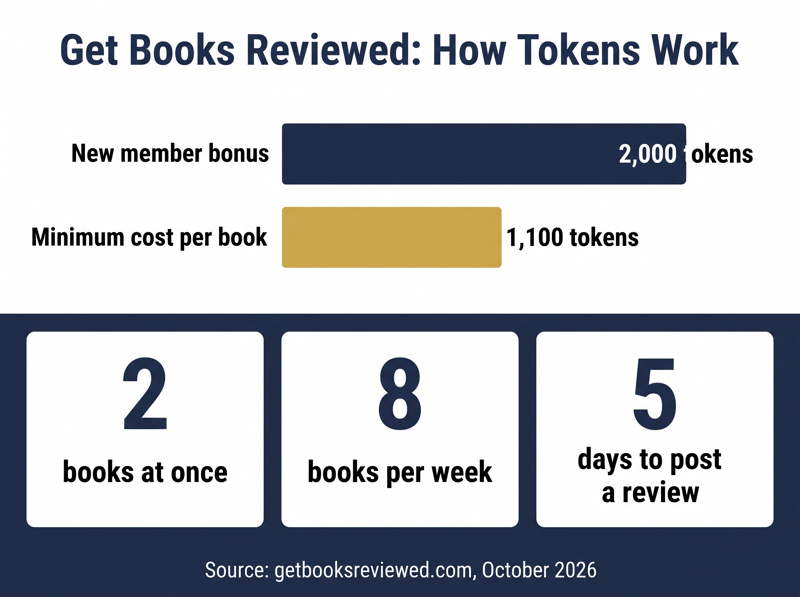
In practice, the welcome bonus covers roughly one listing before you need to start reviewing. On Trustpilot, the service holds a 4.4 out of 5 TrustScore, labeled Excellent, across 17 reviews. The praise centers on fast, polite support, a strong focus on Amazon's Community Guidelines, and reviewers who actually read the book. The single negative review complains about the effort the token system demands and a monthly fee charged regardless of results, and the company disputes that account. Trustpilot also flags that the company has not recently invited customers to review, so the sample is small.
Why do authors look for Get Books Reviewed alternatives?
None of this makes Get Books Reviewed a bad choice. It makes it a specific choice, built for one retailer and one kind of reviewer. Authors who move on usually point to one of four limits.
- Amazon only: reviews on Goodreads, Barnes & Noble, Apple Books, or Google Books sit outside the model||Authors reviewing authors: your reviewers are fellow writers, not necessarily readers who buy in your genre||Time cost: every review you receive is funded by reviews you write, capped at 8 books a week||Paid membership: $180 a year on the annual plan, even in months when you are drafting instead of launching
There is also the compliance question. Reedsy's guide to getting book reviews states plainly that you must not do a review swap with another author and must not offer readers a financial incentive to leave a review. Get Books Reviewed answers this by routing books through an algorithm so no two authors review each other directly. Whether that indirect structure is acceptable is a call Amazon makes, not the platform, so weigh it before you build your whole launch on any token or points system.
What should you compare before switching?
Price is the easiest number to compare and the least useful on its own. Score every candidate on these five factors instead.
- Reviewer source: other authors, matched readers, trade professionals, or a mix||Platform reach: Amazon only, or Goodreads, Barnes & Noble, Apple Books, Google Books, and custom links||Time cost: whether you must review books before you receive reviews||Compliance risk: whether the structure could look like a trade or an incentive||File security: whether your ARC is protected, tracked, or watermarked
Why does the first handful of reviews matter so much? Northwestern University's Spiegel Research Center found that a product with five reviews is 270 percent more likely to be purchased than one with none, and that the marginal benefit of more reviews drops quickly after those first five. The same research found purchase likelihood usually peaks at ratings between 4.0 and 4.7 stars, not at a perfect 5.0. For a new book, the platform that gets you to your first five honest reviews fastest, without risking your account, is usually the right one. Our guide on how many reviews a book needs to sell goes deeper.
1. Read & Rate: multi-platform reviews with watermarked ARCs
Read & Rate is a community platform built around one idea: reviews should reach readers wherever they shop. When a reviewer picks up your ARC, they can post to Amazon (and choose which Amazon storefront), Barnes & Noble, Goodreads, Apple Books, Google Books, or any custom link you add. One campaign can produce reviews on several retailers, which an Amazon-only club does not offer.
File security is built in. Every PDF download is watermarked with the reviewer's email address, so a leaked copy can be traced back to its source. Every reviewer also leaves a private comment visible only to you, which gives you honest craft feedback without cluttering your public reviews. Beyond reviews, you get a community hub for swapping tips with other authors, Book Biometrics analysis of your Amazon listing (cover, title, and description), plus file conversion, watermarking, barcode, and QR code tools. If leaks worry you, read our guide to protecting your book from piracy.
Best for: authors who publish wide, authors on a tight budget, and anyone who wants traceable ARC files. You can start with a free trial.
2. BookSirens: pay per matched reader
BookSirens runs two pricing models. On the Promote plan, you pay a one-time $10 listing fee per book, charged only if BookSirens accepts it, then $2 for each reader who downloads the full file. Readers you invite yourself are not billed. The Author plan costs $100 a year and removes per-reader and per-ARC fees, with unlimited ARCs for two pen names.
The BookSirens homepage cites a community of 51,000+ book reviewers and influencers and says 14,000+ authors and publishers use the service. You can approve or decline readers, send review reminders, and track reviews and DNFs. Remember that you pay for downloads, not guaranteed reviews. Our BookSirens alternatives guide covers the tradeoffs.
Best for: genre fiction authors who want readers rather than fellow authors and can budget per download.
3. StoryOrigin: ARC delivery plus newsletter swaps
StoryOrigin is a marketing toolkit more than a review marketplace. The free Basic plan covers unlimited file delivery, reader tech support, universal retail links, and email marketing integration. The review features, including review history vetting and automated reviewer follow-up, sit in the Standard plan at $10 a month or $100 a year, alongside newsletter swaps and group promos.
That makes StoryOrigin strongest when you already have, or are building, a mailing list. Reviews come from readers you recruit through swaps and promos, not from an exchange. See our StoryOrigin alternatives guide.
Best for: newsletter-driven authors who want reviews and list growth in one tool.
4. Pubby: the original credits marketplace
Pubby describes itself as a review marketplace that connects self-published authors with readers who review on Amazon. Like Get Books Reviewed, it runs on an exchange: you earn credits by reviewing books and spend them on reviews of your own. Its help center references a $240 annual subscription and a monthly option.
Because the mechanics are close to Get Books Reviewed, switching to Pubby changes the community more than the model. Read our Pubby alternatives guide before you commit.
Best for: authors who like the exchange model and want to try a different community.
5. BookBounty: points with mixed author feedback
BookBounty also asks authors to read books to earn points, paired with a monthly fee, according to its users. Its Trustpilot TrustScore is 2.8 out of 5 across 29 reviews, and 55 percent of those reviews are one star. Recurring complaints include slow fulfillment, reviews that authors suspect were written with AI, and a few authors who say Amazon flagged their books for review manipulation. Several reviewers also praise fast, friendly support, so experiences vary.
If you are considering it, read our BookBounty alternatives guide first.
Best for: authors willing to test it carefully on a backlist title, not a launch.
6. Hidden Gems: curated, hands-off ARC campaigns
Hidden Gems runs a managed ARC program. You supply your ebook files and book details, and the team handles distribution to what it calls thousands of reader reviewers. It reports an industry-leading review rate of over 80 percent, meaning 100 reviewers could average more than 80 reviews, while also stating that it makes no guarantees about the number or quality of reviews. Pricing and deposit terms sit in its FAQ, and availability is limited, so book well ahead of your launch.
Best for: authors with a launch date and a budget who would rather not manage outreach themselves.
7. NetGalley: trade reach at a trade price
NetGalley is where librarians, booksellers, educators, and media browse upcoming titles. According to Publishing.co.uk's NetGalley guide, a direct self-published listing costs $575 for a six-month Digital Review Copy listing, aimed at authors listing one to four books a year, and fees are non-refundable. A week-long Featured Title placement adds $150, or $125 when bundled with a listing order. Co-op listings through author groups split the cost.
Review volume is not guaranteed. Reedsy warns that ARC sites charge to list your book for a set period but cannot guarantee how many users will download, read, or review it, and advises using them to complement your own outreach. Compare options in our NetGalley alternatives guide.
Best for: authors who want library and bookseller visibility, not only Amazon reviews.
One more option if you need a professional voice rather than reader reviews: Independent Book Review offers an editorial book review starting at $199, with a guaranteed review in 1 to 5 weeks, plus a free submission route with no guarantee. Editorial quotes work well in your book description and marketing, but they do not replace customer reviews on retailer pages.
How do the costs compare?
Here is what each option costs to get started, based on each platform's own pricing page or help center in October 2026, with NetGalley pricing from Publishing.co.uk's September 2026 check.
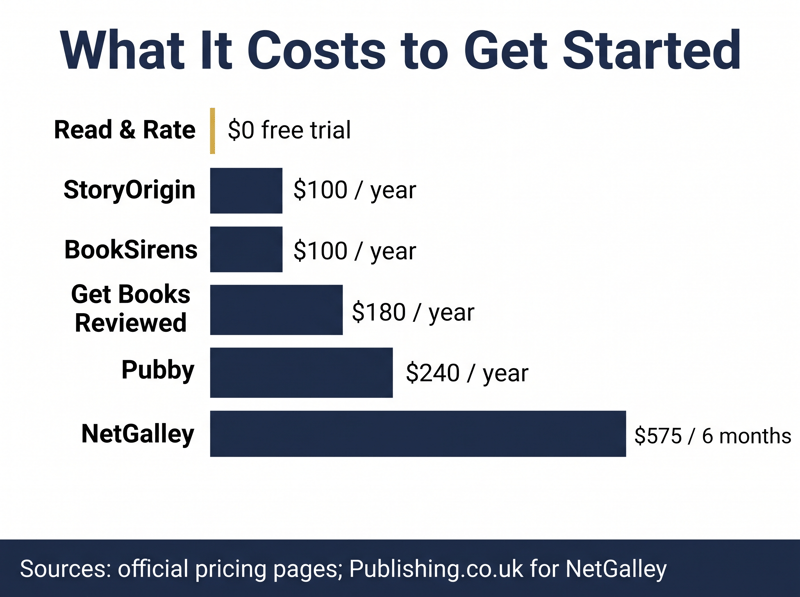
Two caveats. First, Hidden Gems and BookBounty are left out of the comparison because we could not verify their current prices on a public page. Second, sticker price ignores time. On exchange platforms, the real cost includes the hours you spend reading and reviewing other books to earn tokens or credits. If you read slowly or you are deep in drafting, a paid reader-matching model can be cheaper in practice, even at a higher dollar cost.
How do author ratings compare on Trustpilot?
Trustpilot is an imperfect signal for small services. Both pages below note that the companies have not recently invited customers to leave reviews, so the samples are small and self-selected. Still, the gap is wide enough to notice.
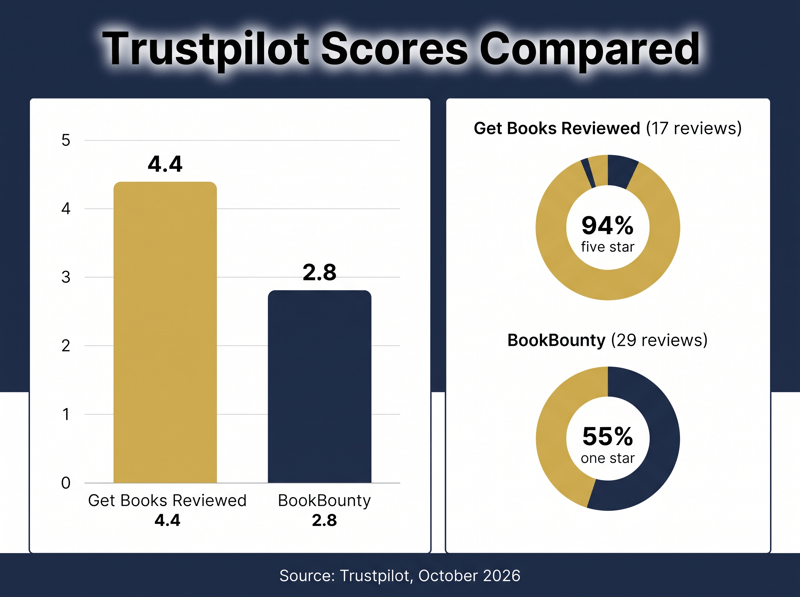
The pattern in the comments matters more than the score. Get Books Reviewed reviewers keep mentioning support and a focus on the rules. BookBounty's negative reviews repeat themes of slow pickup, low-effort reviews, and Amazon flags. When you evaluate any platform, read the one-star reviews first, because they show you the worst realistic outcome.
Which alternative fits your author profile?
- Debut author with no budget: start with the Read & Rate free trial, which needs no token balance and reaches several retailers||Happy on Get Books Reviewed: keep it for Amazon, and add Read & Rate to collect reviews on Goodreads, Barnes & Noble, Apple Books, and Google Books||Publishing wide: Read & Rate for multi-platform reviews, plus StoryOrigin for newsletter reach||Launching with a budget: BookSirens or Hidden Gems for matched readers, NetGalley for trade visibility||Need a quotable professional review: the Independent Book Review editorial option
Stacking is normal. Pairing one community platform with one paid reader-matching service lets you reach different audiences without depending on a single source. It also spreads your risk if any one platform changes its rules or pricing. For the full ARC playbook, see our complete guide to ARC book reviews.
Is a review exchange safe for your Amazon account?
No platform can promise zero risk. Reedsy's summary of Amazon's terms is direct: you must not ask family or close friends to review your book, must not do a review swap with another author, and must not offer readers a financial incentive to leave a review. You can gift an ARC and politely ask for honest thoughts. Our full breakdown is in Amazon review rules for authors.
Federal rules raise the stakes. The FTC's final rule on consumer reviews and testimonials, summarized by law firm Davis Wright Tremaine, bars offering compensation or other incentives conditioned on a review expressing a particular sentiment, positive or negative, and allows civil penalties of up to $51,744 per violation.
A simple safety routine works on any platform you choose:
- Read the platform's own rules and confirm they reference Amazon's Community Guidelines||Test the platform with a backlist title before you use it for a launch||Never tie a reward, discount, or bonus to the content of a review||Keep a record of who received each ARC, which watermarked files do for you automatically||Watch your book pages for removed reviews and pause the platform if removals spike
Frequently asked questions
Reviews are still the multiplier
Whichever platform you choose, the math is the same: your first five honest reviews do the heaviest lifting, and every ad or promo works harder once they are in place. Pick the source that fits your genre, your budget, and your time, then keep it steady. If you want reviews on more than one retailer and a community of authors helping each other get there, Read & Rate is free to try.