Negative Book Reviews: 7 Rules for Handling Them (2026)

Negative book reviews can help sales. Learn 7 rules for handling them: when to report, why not to reply, and what Amazon and FTC rules mean for indie authors.
Do negative reviews actually hurt book sales?
Less than you fear, and sometimes not at all. In its widely cited report How Online Reviews Influence Sales, the Spiegel Research Center at Northwestern University found that purchase likelihood typically peaks at average ratings between 4.0 and 4.7 stars, then declines as ratings approach a perfect 5.0. Shoppers read a spotless score as a warning sign, not a guarantee.
A follow-up study narrowed the range further. In Star Ratings and Review Content (2021), Spiegel researchers looked at more than 40 product categories and found purchase likelihood peaking between 4.2 and 4.5 stars. These studies cover e-commerce products in general, not books specifically, so treat them as a strong signal rather than a law of the Kindle Store. The direction is still clear: a handful of critical reviews sitting next to many positive ones makes your rating more credible.
What does hurt sales is a pattern: a cluster of reviews that all name the same flaw, or a book with so few reviews that one harsh rating drags the average below 4. Both problems are fixable, and the rest of this guide shows you how. If you are still building your first reviews, our breakdown of how many reviews a book needs to sell is a useful companion.
Why do critical reviews make your book more believable?
Readers are shopping for fit, not perfection. A thriller reader who hates slow openings wants to know if your first act is slow. A romance reader who avoids open endings wants to know if yours ends on a cliffhanger. Negative reviews answer those questions faster than your blurb can, and readers know it.
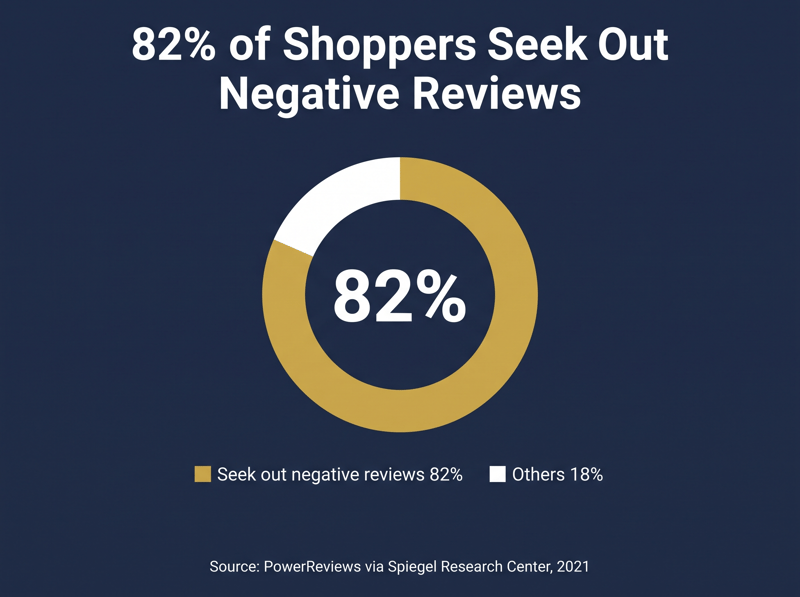
The Spiegel Research Center's 2021 report cites earlier PowerReviews research showing that 82 percent of shoppers specifically seek out negative reviews. The same body of research argues that negative reviews build credibility and authenticity. Spiegel's 2017 work adds a related detail: verified buyer badges improve the odds of purchase by 15 percent, because shoppers care about whether a review comes from a real customer. An honest three-star review from a verified reader often does more for a browsing shopper than a gushing review that sounds like a friend wrote it.
Goodreads puts it bluntly in its Author Guidelines: "Bestselling authors get one star reviews too." Every book that reaches enough readers will eventually reach the wrong ones. A one-star review is often proof that your book is getting discovered beyond your inner circle, which is exactly what you want.
Rule 1: Give yourself 48 hours before you do anything
The first read of a harsh review triggers a fight or flight response. That is human, and it is also the worst moment to type anything. Close the tab, step away, and set a simple rule for yourself: no action on any review for at least 48 hours. Most of the author meltdowns that go viral started with a reply written in the first ten minutes.
When you come back, read the review once as if it were about someone else's book. Ask three questions. Is it about the book or about me? Is it a matter of taste or a fixable problem? Does it break any platform rule? Your answers decide which of the next rules applies. Many authors also stop reading reviews entirely after launch week and ask a trusted friend or assistant to flag only the ones that need attention. That is a legitimate choice, not avoidance.
Rule 2: Never reply publicly to a negative review
This is the rule with the fewest exceptions. Goodreads tells authors directly: "Don't engage with people who negatively rate or review your books." Its guidelines add that engaging with dissatisfied readers "will not win you any new readers," and that because the site is public, any reply can be read as hostile no matter how carefully you word it.
The same logic holds on Amazon. A reply cannot change the star rating, but it can turn a quiet two-star review into a visible argument that every future shopper sees. Even a polite "thank you for your feedback" can make reviewers feel watched, and readers who sense that authors police reviews become less willing to leave honest ones. The math is simple: replying has a small possible upside and a large possible downside.
- Do not reply under the review, even to correct a factual error||Do not ask friends or fans to reply, downvote or argue on your behalf||Do not post about the reviewer on social media, even without naming them||Do not message the reviewer privately to ask for a change||Do vent to a trusted friend or a private author group, offline from the review itself
Rule 3: Report only reviews that break the rules
A review you dislike is not the same as a review that violates policy. Amazon's Community Guidelines list what it removes, and "this reader missed the point" is not on the list. Reporting legitimate opinions wastes your time and can make you look like you are trying to suppress criticism.
According to Amazon's Community Guidelines, these are the kinds of reviews that do qualify for a report:
- Reviews from someone with a financial interest in the product, including competing sellers and authors||Reviews from people with a personal connection to the seller, author, brand or artist||Harassment, threats, or attacks on people the reviewer disagrees with||Profanity, obscenities, or name-calling||Private information such as phone numbers or email addresses||Spam, repetitive text, nonsense, or content that is only punctuation and symbols||Reviews written, edited or removed in exchange for compensation
To report a review on Amazon, select "Report" below it on the product page and choose a reason from the popup. If you suspect a review was paid for, Amazon offers a separate Report Review Compensation form where you can add the product name, up to four images and a detailed comment. On Goodreads, the Author Guidelines say to bring a review that violates the Review Guidelines "to our team's attention rather than responding." Report once, with a clear reason, then let it go. Amazon decides; you do not get a vote on the outcome.
One more detail matters for authors who review other books. Amazon's guidelines say it removes reviews from anyone with a financial interest in a product, and sellers may not review competing products. If you write in the same genre, be careful about reviewing peers' books on Amazon at all. Our guide to Amazon review rules for authors covers the full list of what is and is not allowed.
Rule 4: Never pay, pressure or bargain to remove a review
It is tempting to email a reviewer and offer a free copy of your next book if they reconsider. Do not. Amazon's Community Guidelines prohibit anyone from creating, editing or removing a review in exchange for compensation, and they state that this applies even if a seller offers a refund to remove or change a negative review. A free book, a gift card or a refund all count.
The rules go beyond Amazon. On August 14, 2024, the US Federal Trade Commission voted 5 to 0 to approve a final rule banning fake reviews and testimonials. Among other things, the rule bars businesses from offering compensation or incentives conditioned on reviews expressing a particular sentiment, and from using "unfounded or groundless legal threats, physical threats, intimidation" to prevent or remove negative reviews. It also lets the FTC seek civil penalties against knowing violators. As a self-published author, you are a business selling a product, so these rules apply to you.
The same principle applies to positive reviews. Goodreads states that authors may give away free or discounted copies but "may not require a review in exchange or attempt to influence the review." Gift ARCs freely, ask for honesty, and never tie anything to a star rating. That keeps every review you earn safe from removal.
Rule 5: Mine the criticism for patterns you can fix
One reader disliking your heroine is taste. Five readers saying the middle drags is data. Once the sting fades, collect your two-star and three-star reviews in one document and sort the complaints into groups. Three-star reviews are especially useful, because those readers usually explain what almost worked.
- Typos and formatting errors: fix the file and re-upload it through KDP; a fresh proofread or a professional copyedit solves most of these||"Not what I expected": your cover, title, blurb or categories are attracting the wrong readers, so revisit your book description and category choices||Pacing or structure complaints: note them for the next book, or for a revised edition if the pattern is strong||Content surprises such as violence, explicit scenes or a cliffhanger ending: add a clear line to your description so the right readers self-select||Price or length complaints: compare your page count and price with top sellers in your category
The "not what I expected" group is the most common and the most fixable. When readers who love cozy mysteries pick up your gritty thriller because the cover looks cozy, the problem is positioning, not writing. Our guides to writing an Amazon book description that sells and choosing the right KDP categories walk through how to send clearer signals. For craft issues, the steps in how to self-edit a book are a practical place to start.
Better still, catch these problems before publication. Beta readers give you private criticism while you can still act on it. On Read & Rate, every reviewer also leaves the author a private comment that only you can see, alongside the public review. That gives you a direct line to candid feedback without anyone needing to air it on your product page.
Rule 6: Dilute the negative with more honest reviews
One one-star review among three ratings is a crisis. The same review among fifty is a footnote. The most effective long-term response to negative reviews is not removal, it is volume. Spiegel's 2017 research found that the purchase likelihood for a product with five reviews is 270 percent greater than for a product with no reviews, and that the marginal benefit begins to diminish rapidly after those first five.
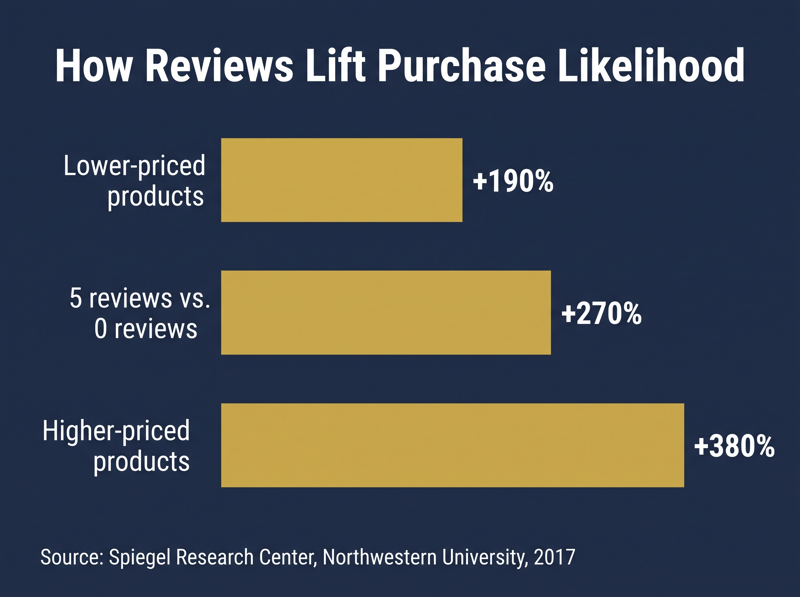
The same study found that reviews matter more as price rises: conversion grew 190 percent for lower-priced products and 380 percent for higher-priced ones when reviews were displayed. For authors, that suggests reviews carry extra weight on paperbacks, hardcovers and box sets, where shoppers have more money at stake than on a 99 cent ebook.
Practical ways to add honest reviews without breaking any rule: send advance review copies to genuine readers before launch, add a short, polite review request at the end of your book, mention reviews in your newsletter, and use an ARC platform that lets readers choose your book freely. Our complete guide to ARC book reviews explains how to run this process from start to finish, and our Goodreads reviews guide covers the reader side of the platform.
Rule 7: Protect your energy and your author brand
Negative reviews are a career-long reality, so treat your response as a system rather than a series of emergencies. Decide in advance when you read reviews, who you talk to about them, and what you will never do. Write that down. When the next one-star review lands, you follow the plan instead of your adrenaline.
Community helps more than willpower. Other authors have read the same kind of review about their own books, and they can tell you in thirty seconds whether a critique is worth acting on. Private spaces such as the community hub inside Read & Rate, or the groups covered in our guide to self-published author communities, give you a place to vent and compare notes without any risk of it reaching the reviewer. Your public brand stays calm and professional, which is what readers remember.
What if a negative review looks fake or malicious?
Sometimes a review is not an honest opinion at all. Signs include a review that clearly describes a different book, a burst of one-star ratings on the same day from accounts with no other activity, or a reviewer who appears connected to a competing author. These cases are exactly what platform reporting tools exist for, and Amazon is investing heavily in catching them.
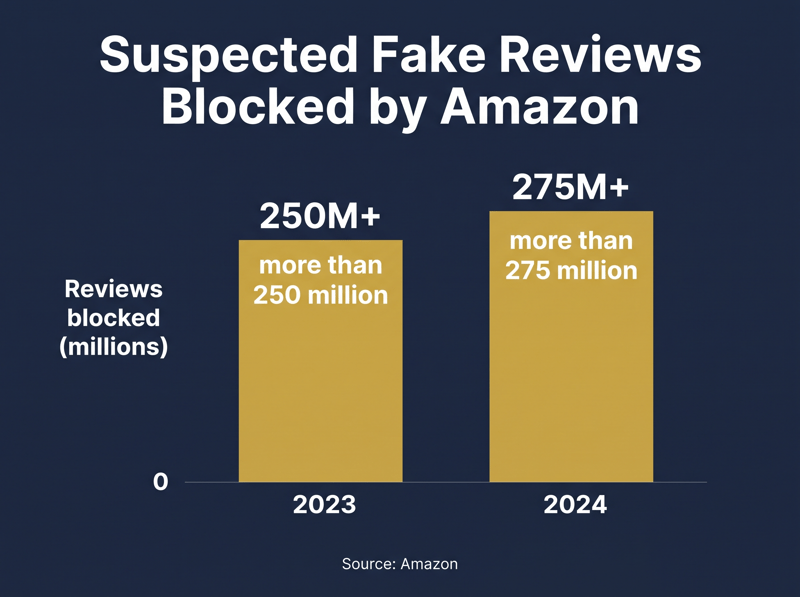
According to Amazon's report on its actions against fake review brokers, the company proactively blocked more than 250 million suspected fake reviews in 2023 and more than 275 million in 2024. It also says it pursued legal action against more than 150 bad actors in 2023. Much of this filtering happens before a review ever appears, which is one reason legitimate reviews sometimes take time to show up or disappear unexpectedly.
If you believe a review is fake or part of a coordinated attack, report each review with the most specific reason available, keep screenshots with dates, and use the Report Review Compensation form if you have evidence the reviews were paid for. Stay factual and unemotional in every report. Do not try to identify or confront the person behind the reviews yourself, and never respond with reviews of your own on their books.
Your negative review response checklist
- Wait at least 48 hours before taking any action||Decide whether the review is about taste, a fixable problem, or a rule violation||Do not reply publicly, message the reviewer, or ask anyone to reply for you||Report only clear guideline violations, once, with a specific reason||Never offer refunds, free books or any perk to change or remove a review||Log recurring complaints and fix what is fixable in the file, blurb, cover or categories||Keep collecting honest reviews from real readers so each rating carries less weight||Talk it through in a private author community, not in public
Frequently asked questions
Turn one bad review into a better book
Negative book reviews are not a verdict on your talent. They are a sign that your book is reaching real readers, a source of free market research, and in small numbers, a credibility boost. Stay quiet in public, report only what breaks the rules, never bargain over a rating, and keep putting your book in front of the right readers. Over time, the honest reviews pile up and the harsh ones fade into the context they deserve.
If you want a steady flow of honest reviews from readers who chose your book, private feedback you can actually use, and a community of authors who understand what a one-star review feels like, Read & Rate was built for exactly that. Start your free trial and see how it fits your next launch.